
Oracle Kubernetes Engine (OKE) Part#3
Enterprise Architecture Patterns, Scaling Strategies, Governance, and Lessons from the Field
Ahmed Hassan
7/7/202627 min read
Kubernetes Doesn’t Fail. Platform Decisions Do.
If you have spent enough time around Kubernetes, you have probably heard someone say that it is too complicated. I do not entirely agree. Kubernetes is certainly a sophisticated platform, but in my experience, most production issues are not caused by Kubernetes itself. They are caused by architectural decisions made long before the first pod is ever scheduled.
A networking model that seemed reasonable at the outset stops working once another business unit needs access. A cluster designed for a single development team ends up shared by twenty. A deployment pipeline that worked comfortably with five applications becomes unmanageable once the portfolio grows to two hundred. Identity policies expand gradually until nobody is entirely sure who can reach production anymore. None of these problems originate in Kubernetes they are consequences of design decisions. That is why enterprise architecture deserves far more attention than any individual Kubernetes feature. A well-designed platform makes everyday operations feel routine; a poorly designed one forces engineers to compensate for its limitations every single day.
This series looks beyond commands, YAML manifests, and OCI Console screenshots, and focuses instead on the choices that shape a Kubernetes platform over the following three to five years because that is the horizon architects should actually be designing for.
Enterprise Architecture Starts Before the Cluster Exists
A pattern I have noticed repeatedly in architecture workshops is that the conversation tends to begin with Kubernetes itself: which version to deploy, how many worker nodes are needed, which compute shape is appropriate, whether to use Managed Nodes or Virtual Nodes. These questions matter, but they are rarely the first ones I ask. Instead, I usually start with a different conversation: How many business units will use this platform? Will workloads need to be isolated for compliance reasons? Are multiple OCI regions involved? Will applications need to communicate with on-premises systems? Is there an existing identity provider? How will disaster recovery be handled? Who owns the platform once it is implemented?
The answers to those questions influence nearly every technical decision that follows. Architecture is not about selecting technologies it is about understanding constraints before selecting technologies.
The First Architecture Decision Isn’t Kubernetes It’s the Landing Zone
Every enterprise Kubernetes platform eventually depends on the quality of its underlying cloud foundation: networking, identity, governance, logging, security, and shared services. None of these capabilities should be designed independently for each new cluster; they belong in a standardized Landing Zone. Establishing the Landing Zone before provisioning OKE prevents infrastructure from growing organically without clear boundaries. I have seen environments where every project created its own networking model, its own IAM policies, its own logging standards, and its own DNS conventions. That flexibility accelerated delivery at first, but a few years later it had significantly increased operational complexity. Consistency established early becomes a long-term advantage.
Designing an OCI Landing Zone
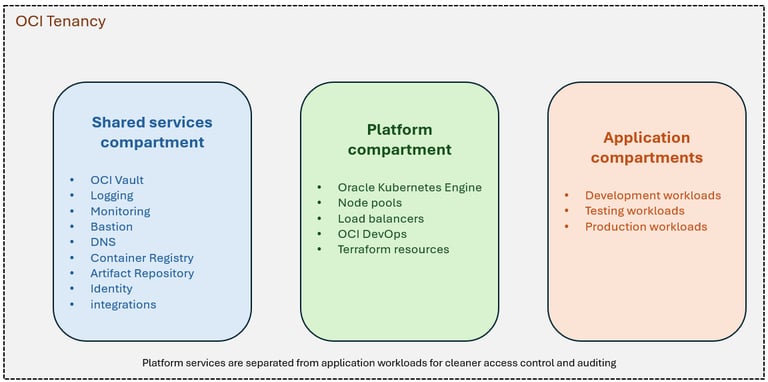
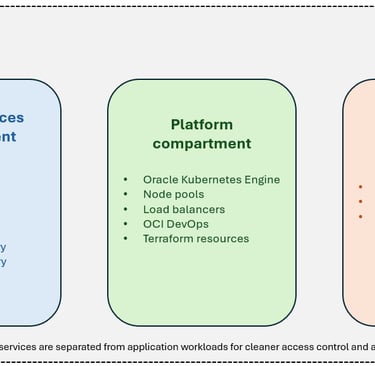
When I design an OCI Landing Zone, I try to separate shared responsibilities from application responsibilities. A simplified structure typically includes:
This structure is not mandatory; every organization has different governance requirements but the underlying principle, separating platform services from application workloads, holds true across environments. Doing so simplifies access control, auditing, and long-term administration.
Architecture Should Minimize Blast Radius
A phrase that comes up constantly in architecture reviews is blast radius: how much of the environment is affected when something goes wrong. Good architecture reduces blast radius; poor architecture expands it. Picture a shared Kubernetes cluster supporting dozens of unrelated business applications. A networking mistake, an accidental namespace deletion, an overly permissive network policy, or a resource-exhaustion issue can affect multiple teams simultaneously. Now picture the same workloads distributed according to clear business or operational boundaries the impact becomes dramatically smaller. When evaluating architecture, I often ask a simple question: “If this component fails, who else notices?” The fewer answers to that question, the better.
Shared Cluster or Multiple Clusters?
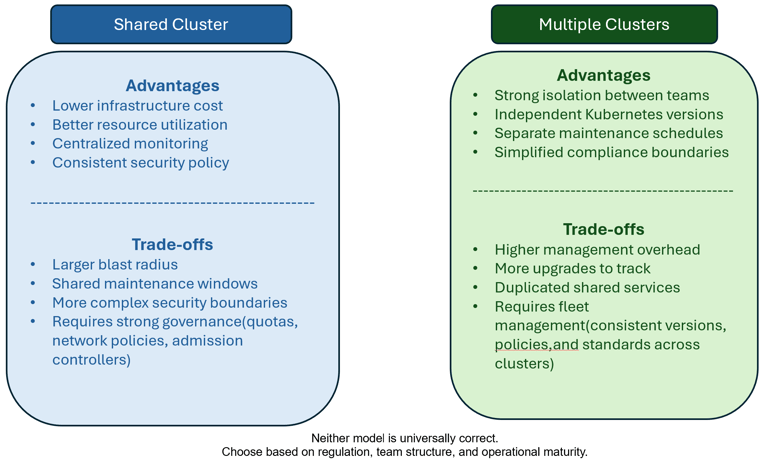
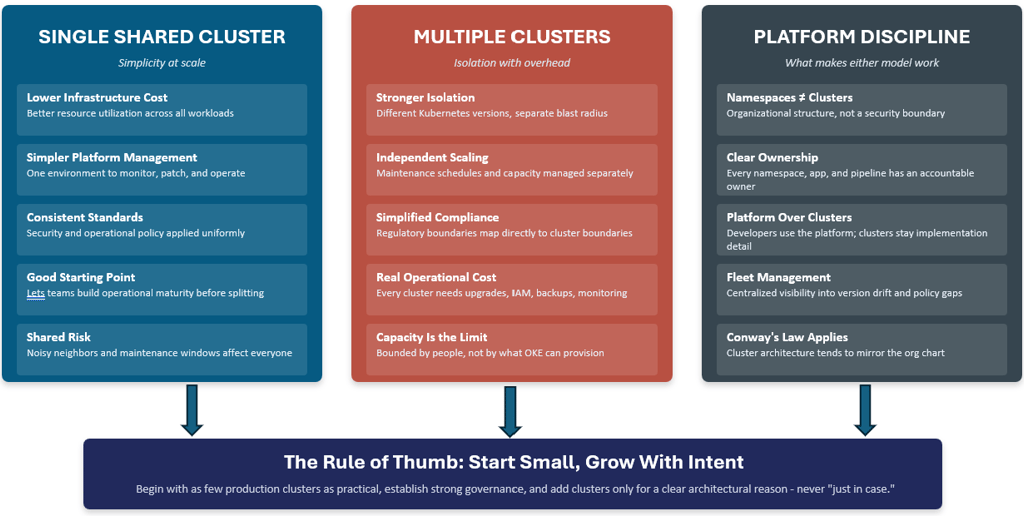
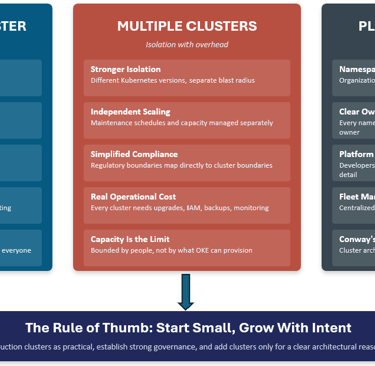
Few Kubernetes topics generate as much debate as cluster strategy: one large shared cluster, or several smaller ones? A shared cluster offers clear advantages: lower infrastructure costs, better resource utilization, simpler platform management, and consistent operational standards. But shared clusters also increase dependency between teams; maintenance windows affect everyone, security boundaries become more complex, and resource contention becomes more likely. Multiple clusters introduce additional management overhead but improve isolation: different Kubernetes versions become possible, maintenance schedules can be separated, scaling becomes independent, compliance is simplified, and operational risk is reduced.
I do not believe either model is universally correct. Instead, I evaluate factors such as regulatory requirements, team structure, business criticality, geographic distribution, and operational maturity. Architecture should reflect organizational reality, not theoretical best practice.
Architect’s Note
One observation has stayed with me throughout many enterprise engagements: organizations rarely regret creating a well-designed Landing Zone, but they frequently regret postponing it. Building applications is exciting; designing governance is not. Yet governance decisions influence every application that follows. The earlier those foundations are established, the easier the platform becomes to evolve. That is one reason I encourage architects to resist the pressure to deploy clusters immediately; spending an extra week designing the foundation can save months of operational effort later.
Network Architecture: Designing for Growth Instead of Day One
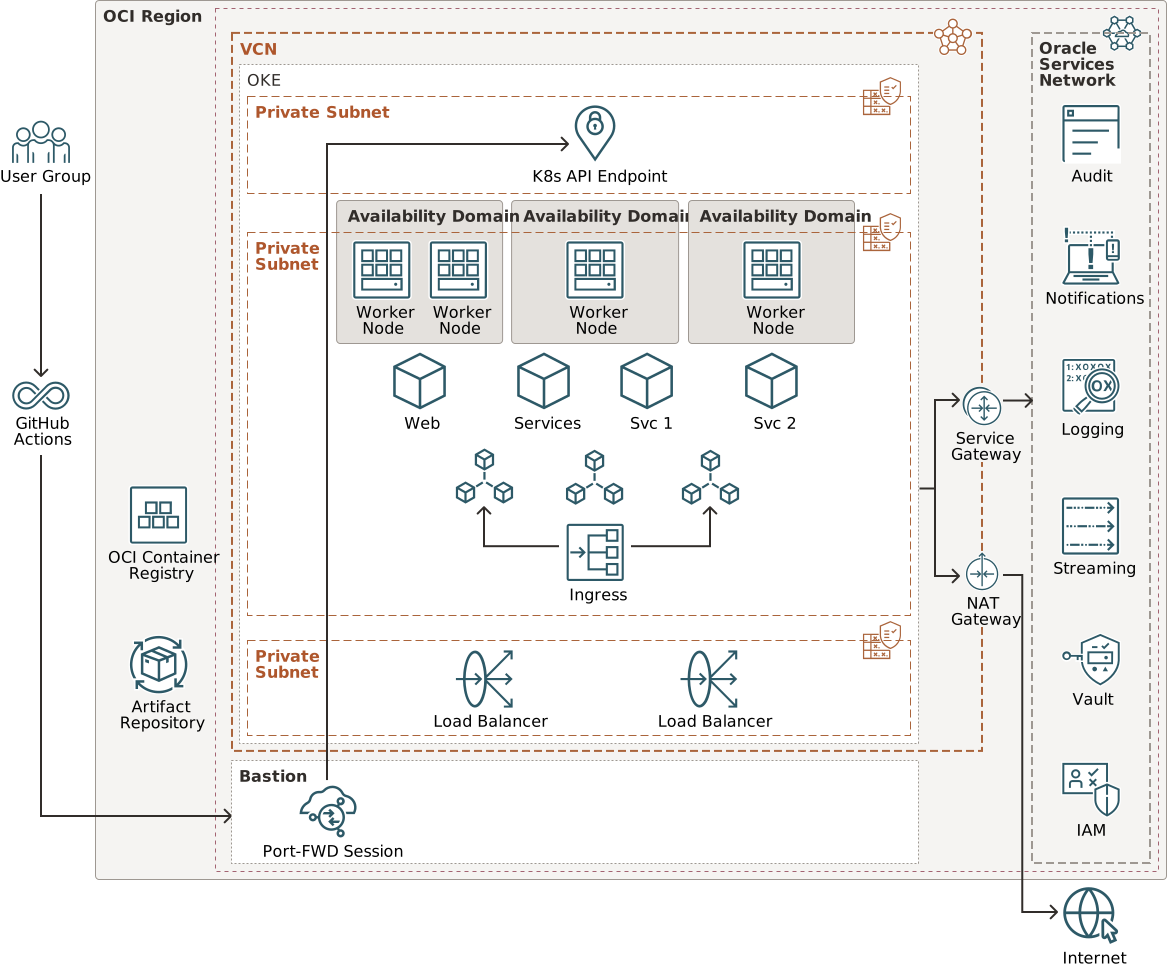
Ask ten architects what makes a Kubernetes platform successful and you will likely hear ten different answers: automation, security, observability. My answer is usually networking. Not because it is more important than everything else, but because it is one of the few architectural decisions that is genuinely painful to change once production workloads arrive. Changing a CI/CD pipeline is manageable. Replacing a monitoring platform takes planning. Redesigning the network that hundreds of applications depend on is an entirely different level of effort which is why networking deserves more time in architecture workshops than most people expect.
https://docs.oracle.com/en/solutions/deploy-oke-with-bastion-and-github/index.html
Networks Should Reflect the Business, Not the Technology
A mistake I have seen repeatedly is designing networks around Kubernetes rather than around the organization. A team creates a VCN because it is deploying OKE. Another VCN appears because a new project starts. A third appears because a department needs its own environment. At first it feels logical; months later, engineers are trying to understand why dozens of VCNs exist, each with slightly different routing tables, security lists, DNS settings, and peering configurations. The network becomes a history lesson rather than an architecture.
Instead, I prefer to start with business boundaries: Which applications communicate frequently? Which systems require strict isolation? Which workloads fall under different compliance requirements? Which services must remain private? Those answers should shape network design far more than the technology running inside it. Technology changes; business relationships tend to change more slowly.
Hub-and-Spoke Has Endured for a Reason
Over the years I have seen many networking models come and go, but the hub-and-spoke pattern remains one of the most practical approaches for enterprise OCI environments. Rather than letting every VCN connect directly with every other VCN, shared services are centralized in a hub, which typically contains DNS, Bastion services, OCI Firewall or Network Firewall, logging, shared monitoring, identity integrations, central egress controls, and shared management tools. Application environments remain in spoke VCNs. Traffic flows through predictable paths, security policies become easier to manage, auditing improves, and operational ownership becomes clearer. Most importantly, the architecture scales adding another application environment does not require redesigning the entire network.
Don’t Let Every Cluster Become Its Own Island
It is tempting to give every Kubernetes cluster complete networking independence its own routing, its own gateways, its own DNS, its own security rules. Initially this feels safe. The problem appears later: shared services become duplicated, operational standards drift, and connectivity between environments becomes increasingly inconsistent. I generally encourage organizations to standardize networking services wherever practical while still allowing application teams to remain autonomous within clearly defined boundaries. Standardization does not reduce flexibility it reduces surprises.
Private Clusters Aren’t Automatically Better
Whenever Kubernetes security comes up, someone inevitably recommends private clusters. It is understandable removing public access sounds like the obvious security improvement. Sometimes it is; sometimes it simply moves complexity elsewhere. A private API endpoint introduces new operational considerations: developers need secure connectivity, CI/CD platforms require network access, and platform engineers often depend on Bastion hosts, VPN connections, OCI Cloud Shell, or FastConnect. Troubleshooting becomes more dependent on the surrounding network architecture.
Would I recommend private clusters for production? In many enterprise environments, yes especially where regulatory requirements or strict security controls apply. But I do not treat “private” as a universal objective; I treat it as one architectural decision among many. Security should be evaluated as an end-to-end design, not a collection of isolated features.
FastConnect Is About Predictability, Not Speed
A common misconception is that FastConnect exists primarily to make applications faster. Latency improvements certainly matter, but they are rarely the main reason enterprises invest in dedicated connectivity. The real value is predictability. Public internet paths change, congestion varies, and routing evolves, whereas dedicated private connectivity provides consistent performance characteristics and operational confidence. For organizations integrating OCI with existing data centers, ERP systems, manufacturing platforms, or financial applications, predictable connectivity often matters more than raw throughput. Reliability is difficult to measure when everything works it becomes immediately noticeable when it does not.
Hybrid Cloud Changes the Conversation
Very few enterprises begin with a blank canvas. Most already operate infrastructure elsewhere private data centers, Microsoft Azure, AWS, Google Cloud, Oracle Exadata, VMware environments, or mainframes. Kubernetes does not eliminate those investments; instead, architects need to decide how workloads communicate across them. That makes networking less about Kubernetes and more about integration: Can authentication remain centralized? How is DNS resolved? Where are firewalls enforced? Which applications remain on-premises? How is latency managed? How are overlapping IP ranges avoided? Hybrid architecture is rarely constrained by Kubernetes itself it is constrained by the surrounding ecosystem.
Service Gateways Are Often Underappreciated
Whenever possible, I encourage keeping OCI service traffic on Oracle’s private backbone. Service Gateway makes this straightforward: instead of sending requests for services such as Object Storage, Vault, or Container Registry across the public internet, workloads communicate privately. Operationally, this reduces exposure, simplifies security policies, provides predictable routing, and reduces outbound internet dependencies. Keeping internal OCI traffic inside OCI is one clear example of reducing unnecessary complexity a theme that runs throughout this series.
DNS Deserves More Attention Than It Gets
Networking discussions often revolve around IP addressing and routing, while DNS receives far less attention. That is unfortunate, because naming standards influence operational clarity for years. Imagine troubleshooting a production incident across dozens of environments with inconsistent naming conventions engineers waste time simply identifying resources before they can begin solving the actual problem. Good naming does not feel exciting, and neither does good documentation, yet both become invaluable as environments grow. I strongly encourage organizations to define naming conventions before infrastructure deployment begins, not afterward.
Multi-Region Isn’t Just Disaster Recovery
Many architects associate multiple OCI regions exclusively with disaster recovery. That is certainly one use case, but not the only one regional expansion, data residency, latency optimization, business continuity, regulatory compliance, and global customer distribution all shape regional architecture, often long before disaster recovery enters the discussion. One question I frequently ask is: “If your business doubles over the next three years, will today’s network architecture still make sense?” Architects are not designing for today’s traffic; they are designing for tomorrow’s business.
Avoid Building a Network That Only One Person Understands
One of the most fragile architectures I have encountered was technically brilliant custom routing, sophisticated automation, advanced firewall policies, elegant segmentation but only one engineer truly understood how it all worked. When that engineer left the organization, operational confidence disappeared almost overnight. That experience reinforced an important lesson: architecture should optimize for maintainability, not cleverness. The best network designs are not the most sophisticated ones; they are the ones experienced engineers can understand without requiring a guided tour from the original architect.
Architect’s Note
Whenever I review enterprise OCI environments, I try to imagine what the platform will look like five years from now not next month, not after the initial migration. Will adding another business unit require redesigning the network? Will another OCI region fit naturally into the existing architecture? Can another platform team understand the topology quickly? Can security policies evolve without rewriting every route table? If the answer to those questions is yes, the network has probably been designed well. If every future change feels like a special project, the architecture may already be showing signs of strain. Networking is one of the few decisions that becomes more expensive to change with every application deployed which is exactly why it is worth getting right early.
One Cluster or Many? The Question Every Enterprise Eventually Asks
One of the first architectural questions organizations ask after adopting Kubernetes sounds deceptively simple: “How many clusters should we build?” It sounds like a capacity-planning exercise, but it is not it is really a question about organizational design. I have seen companies running thousands of applications successfully on fewer than ten Kubernetes clusters, and I have seen organizations running fifty clusters with only a handful of applications. Neither approach was inherently right or wrong; each reflected different business priorities, security requirements, operational maturity, and team structures. That is why I rarely begin this conversation by talking about Kubernetes at all I ask questions about the organization itself.
Your Organization Chart Will Eventually Influence Your Cluster Architecture
Conway’s Law quietly appears in almost every Kubernetes environment: teams build systems that resemble the way the organization communicates. A centralized platform engineering team often leads to shared Kubernetes platforms; independent business units frequently prefer independent clusters; separate regulatory domains usually require stronger isolation; different release schedules often become different operational boundaries. Architects sometimes try to fight this reality I have found it is usually better to embrace it. Technology should support the organization, not force the organization to change simply because Kubernetes allows a particular deployment model.
The Appeal of a Single Shared Cluster
At first glance, one shared enterprise cluster is attractive: infrastructure costs remain low, resource utilization improves, monitoring becomes centralized, platform upgrades are easier to coordinate, security policies remain consistent, and operations teams manage fewer environments. For organizations beginning their Kubernetes journey, this simplicity is genuinely valuable instead of spreading limited expertise across multiple clusters, engineers can concentrate on building operational maturity. In many cases, a single production cluster is exactly the right starting point. The mistake is assuming it will remain the right answer forever.
Shared Infrastructure Also Creates Shared Risk
Every architectural decision involves trade-offs, and shared clusters are no exception. Imagine twenty development teams deploying into the same production cluster: one team introduces an aggressive Horizontal Pod Autoscaler configuration, another deploys an application with incorrect resource requests, a third fills persistent storage unexpectedly. None of these incidents were intended to affect anyone else, yet they can. Shared infrastructure naturally increases the blast radius of operational mistakes. That does not mean shared clusters are flawed it means they require stronger governance: resource quotas, LimitRanges, Pod Security standards, network policies, admission controllers, and clear namespace ownership. Without those guardrails, operational discipline gradually becomes optional, and optional standards rarely stay standards for long.
Multiple Clusters Introduce Different Challenges
The alternative is equally familiar: every department requests its own cluster. Development has one, testing has another, production has three, data science builds two more, and a separate cluster appears for every major initiative. Initially, teams appreciate the independence. Then operational reality catches up every cluster requires upgrades, monitoring, backup policies, IAM configuration, security reviews, Terraform state, cost management, documentation, certificate rotation, and platform support. Five clusters may feel manageable; fifty clusters become an operational platform in their own right, and at that point engineers are no longer managing applications they are managing Kubernetes itself.
Cluster Count Should Reflect Operational Capacity
A question I frequently ask platform teams is: “How many Kubernetes clusters can your team realistically operate well?” Notice this is not a question about how many clusters OCI can create Oracle Kubernetes Engine can provision clusters quickly. The limiting factor is not technology; it is people. Every additional cluster increases operational responsibility. If adding another cluster means another engineer carries more overnight support, another upgrade schedule, another monitoring dashboard, and another disaster recovery plan, the cost of that cluster extends well beyond OCI billing. Architecture decisions should treat operational capacity as a first-class design constraint.
Namespaces Are Organizational Boundaries
Many discussions compare namespaces with clusters as though they solve the same problem they do not. Clusters provide infrastructure isolation; namespaces provide organizational structure. Namespaces work well for separating applications that share operational characteristics, such as development teams, business domains, microservices, projects, or environments. They become far less effective when organizations try to use them as security boundaries for unrelated tenants with significantly different compliance requirements. Namespaces reduce administrative complexity, but they should not replace architectural isolation where true separation is required.
Multi-Tenancy Requires Clear Ownership
The term multi-tenancy often appears on architecture diagrams; in practice, it means something much simpler who owns what? Every namespace should have an identifiable owner, every application a responsible team, every deployment pipeline clear accountability, and every cost a traceable origin. The technology involved is not particularly difficult; the governance often is. Successful multi-tenant platforms invest as much effort in ownership models as they do in Kubernetes configuration, because ownership creates clarity, and clarity reduces operational friction.
Build a Platform, Not a Collection of Clusters
There is an important distinction between cluster management and platform management. Managing clusters means provisioning Kubernetes, applying patches, monitoring nodes, rotating certificates, and managing upgrades. Platform management goes further it standardizes deployment patterns, security controls, identity, observability, developer onboarding, documentation, automation, and service catalogs. Developers should not need to know which cluster they are using; they should interact with the platform. That is an important architectural shift: clusters become implementation details, and the platform becomes the product.
Fleet Management Becomes Essential
Once an organization operates several Kubernetes clusters, consistency becomes more important than individual configuration. Are all clusters running supported Kubernetes versions? Which clusters still allow deprecated APIs? Which environments are missing security policies? Which clusters have not received the latest platform update? Without centralized fleet management, these questions become manual investigations. Consistency across clusters is often more valuable than perfection within any single cluster enterprise operations reward predictability.
My Rule of Thumb
I do have a preferred model, though it is more of a progression than a fixed rule: start with as few production clusters as practical, establish strong governance, automate everything, and measure operational maturity. Only introduce additional clusters when there is a clear architectural reason regulatory isolation, regional expansion, business continuity, operational independence, acquisitions, or distinct platform ownership. Adding clusters because “we might need them one day” rarely produces a better platform; it usually just produces more administration.
Architect’s Note
One of the most expensive mistakes I have seen was not building too many clusters it was building them too early. Every cluster introduces an operational commitment that lasts for years. The excitement of provisioning a new environment fades quickly; the responsibility for maintaining it does not. Whenever I am asked whether a new cluster should be created, I try to answer a different question first: “Which problem becomes impossible to solve without another cluster?” If that answer is not convincing, it is often better to strengthen the existing platform rather than expand it. Growth should be intentional, not automatic.
Performance Engineering: Designing for Efficiency, Not Just Scale
One of the biggest misconceptions surrounding Kubernetes is that it automatically makes applications scalable. It does not. Kubernetes provides the mechanisms to scale, but whether an application actually scales depends on architecture, workload characteristics, resource allocation, and operational discipline. I have seen applications double their capacity simply by adjusting resource requests, and I have also seen clusters with hundreds of CPUs struggle under relatively modest workloads because inefficient applications kept requesting more infrastructure instead of solving the underlying problem. Scaling is easy; scaling efficiently is considerably harder.
Performance Begins Long Before Production
Many performance discussions begin only after users report that an application has become slow by then, engineers are already reacting. Performance engineering should start much earlier. During architecture reviews, I usually ask questions that have nothing to do with Kubernetes itself: Is this workload CPU intensive? Memory intensive? Network intensive? Latency sensitive? Batch oriented or interactive? Stateful or stateless? Each answer influences scheduling decisions, node selection, storage architecture, and autoscaling strategy. Performance is not something Kubernetes adds later it is something architects design from the beginning.
Resource Requests Are Promises
One concept developers often underestimate is the difference between resource requests and resource limits. Requests are not merely recommendations; they are promises made to the Kubernetes scheduler. When an application requests four CPUs, Kubernetes assumes those resources will eventually be required, regardless of whether the application actually consumes them. I have reviewed clusters where workloads consistently consumed less than 20 percent of the CPU they requested. From Kubernetes’ perspective, nothing was wrong the scheduler simply honored the requests it received. The result was poor utilization, unnecessary node expansion, and steadily increasing cloud costs. Resource requests deserve periodic review; they should not become permanent simply because they were defined during the first deployment.
Bigger Nodes Don’t Always Mean Better Performance
It is tempting to solve performance concerns by choosing larger compute shapes more CPU, more memory problem solved. Sometimes that works. Large nodes reduce scheduling pressure, but they also increase the impact of failures. Imagine a node hosting fifty critical pods: if that node becomes unavailable, fifty workloads require rescheduling simultaneously. Smaller node pools often improve resilience because workloads naturally distribute across more failure domains. Choosing node size is therefore a balance between efficiency and operational risk, and like many architectural decisions, there is no universal answer.
Separate Workloads With Different Characteristics
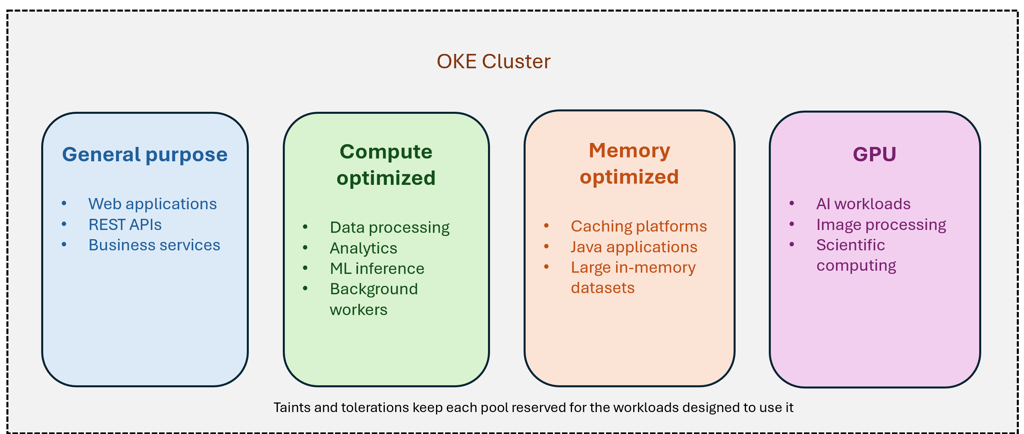
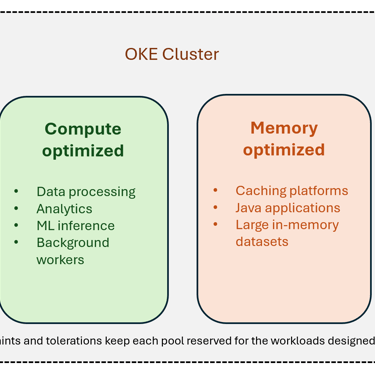
I recommend creating dedicated node pools for different workload profiles whenever a platform begins supporting multiple business applications. For example, a general-purpose pool for web applications, REST APIs, and business services; a compute-optimized pool for data processing, analytics, machine learning inference, and background workers; a memory-optimized pool for caching platforms, Java applications, and large in-memory datasets; and a GPU pool for AI workloads, image processing, and scientific computing. This separation provides two benefits: applications receive infrastructure suited to their requirements, and operational tuning becomes far easier because similar workloads share similar characteristics. Trying to optimize a single node pool for every application usually produces compromises everywhere.
Affinity Should Express Intent
One of Kubernetes’ greatest strengths is allowing architects to describe where workloads should run without specifying individual servers. Node Affinity, Pod Affinity, and Pod Anti-Affinity are often introduced as scheduling features, but I think of them differently they are architectural intent expressed as code. Consider a payment platform: would you want every payment service replica running on the same physical node? Probably not Pod Anti-Affinity communicates that requirement directly. Likewise, analytics workloads may benefit from staying close to specialized storage, and affinity expresses that relationship. Good scheduling policies reflect business requirements, not infrastructure preferences.
Taints and Tolerations Protect Specialized Infrastructure
Dedicated node pools eventually raise another question: how do we prevent every workload from using them? This is where taints and tolerations become valuable. Imagine provisioning expensive GPU instances for a machine learning team without scheduling controls, any workload could potentially land there, which is an expensive mistake. Taints protect specialized resources, so that only workloads explicitly designed to use them receive permission to run there. I view taints less as a Kubernetes feature and more as a governance mechanism one of the simplest ways to prevent accidental resource misuse.
High Availability Isn’t Automatic
Many people assume that deploying multiple replicas automatically creates high availability. Sometimes it does; sometimes every replica ends up on the same worker node, or worse, inside the same availability domain and a hardware failure then removes every replica simultaneously. That is not resilience; that is coincidence. Topology Spread Constraints changed how I approach this problem: instead of hoping Kubernetes distributes workloads sensibly, architects can explicitly define how replicas should be balanced across nodes, availability domains, or fault domains. The platform stops relying on assumptions, and availability becomes intentional.
Horizontal Scaling Is Usually the Right Starting Point
The Horizontal Pod Autoscaler (HPA) has become the default scaling strategy for many cloud-native workloads, for good reason. Adding another application instance generally introduces less operational risk than increasing the size of an existing one: smaller replicas recover faster, rolling updates become smoother, failures affect fewer users, and capacity grows incrementally. Most stateless applications fit this model extremely well. That does not mean HPA should be enabled everywhere it means horizontal scaling deserves consideration before vertical scaling.
Vertical Scaling Has Its Place
Some applications do not scale horizontally commercial software, legacy systems, large JVM applications, stateful services, and databases. In these situations, the Vertical Pod Autoscaler (VPA) can provide meaningful improvements by adjusting CPU and memory allocations according to observed behavior. One caution: vertical scaling sometimes masks inefficient software. If memory usage continually grows because of a leak, allocating more memory only postpones the problem rather than solving it. Scaling should support healthy applications, not compensate for unhealthy ones.
Cluster Autoscaler Should Reflect Business Demand
Cluster Autoscaler is often demonstrated using synthetic load tests traffic increases, nodes appear; traffic decreases, nodes disappear. The demonstration is impressive, but production environments are rarely that predictable. Scaling decisions should reflect real business patterns: retail platforms experience seasonal peaks, universities experience enrollment periods, banks observe end-of-month processing, and healthcare systems often display predictable daily cycles. Understanding those patterns allows architects to tune scaling behavior far more intelligently than generic default settings ever could. Infrastructure should respond to business demand, not merely CPU percentages.
Performance Is About Removing Bottlenecks
A habit I have developed during performance reviews is resisting the urge to optimize everything. Instead, I look for the single constraint limiting the entire system sometimes CPU, sometimes storage latency, sometimes network throughput, sometimes a database connection pool, sometimes a third-party API. Scaling components that are not limiting performance simply increases infrastructure cost. Performance engineering is often less about making systems faster and more about identifying what actually prevents them from being fast.
Architect’s Note
One of the most expensive production environments I reviewed was not overloaded it was oversized. Nearly every application requested significantly more CPU and memory than it consumed. Autoscaling kept adding nodes because the scheduler believed additional capacity was required, and monitoring showed healthy utilization simply because the applications were barely using the resources allocated to them. Nothing was technically broken; the organization was simply paying for capacity it never needed. That experience reinforced an important lesson: performance optimization and cost optimization are rarely separate conversations. Efficient platforms are often both faster and less expensive, because resources are allocated intentionally rather than generously.
Governance, FinOps, and Building a Platform That Can Scale with the Business
One of the first things I noticed after moving from traditional infrastructure into cloud architecture was how quickly cloud environments evolve. Provisioning a virtual machine used to require approvals, procurement, and waiting; today, a development team can provision infrastructure in minutes. That is one of cloud computing’s greatest strengths and one of its biggest risks. Without governance, speed eventually turns into inconsistency: different naming conventions, different tagging strategies, different security policies, different backup standards, different deployment processes. None of these decisions seem particularly important on the day they are made, but a year later they define how manageable the platform has become. Governance is not about slowing engineers down it is about making growth sustainable.
Governance Begins with Standards
Whenever I join a new cloud project, one of the first questions I ask is surprisingly simple: “Do you have documented platform standards?” Not architecture diagrams, not Terraform code standards. How are resources named? Which OCI compartments should teams use? Which labels and tags are mandatory? How are Kubernetes namespaces created? How are production deployments approved? Where should secrets live? How are container images versioned? If those answers differ between teams, operational consistency gradually disappears. Technology rarely creates complexity on its own inconsistent decisions do.
Standardization Doesn’t Limit Innovation
Some engineers hear the word “standardization” and immediately worry about losing flexibility. I have found the opposite to be true. Standards remove repetitive decisions developers should not spend time debating naming conventions, logging formats, label structures, or monitoring annotations; those decisions should already exist. Once a platform establishes sensible defaults, engineers can focus their creativity where it actually matters: building applications. Consistency creates room for innovation, not the other way around.
FinOps Isn’t Just About Reducing Costs
Cloud cost optimization is often misunderstood. When executives hear the term “FinOps,” they sometimes expect aggressive cost-cutting initiatives, but that is only one part of the discipline. FinOps is really about understanding how technology spending supports business value. A Kubernetes cluster serving millions of customers may cost significantly more than an internal development environment, and that is not necessarily a problem the important question is whether the investment aligns with the business outcome. Good FinOps does not ask “How do we spend less?” It asks “Are we spending wisely?” a much healthier conversation.
If You Can’t Attribute the Cost, You Can’t Manage It
One of the quickest ways to lose visibility in a cloud environment is failing to establish a consistent tagging strategy. Imagine receiving a monthly OCI invoice totaling hundreds of thousands of dollars, then trying to answer which department generated these costs, which application consumed the most compute, which environments are underutilized, and which projects exceeded their budgets. Without meaningful tags, those answers become difficult to obtain. That is why I treat tagging as an architectural requirement rather than an administrative task: every significant resource should communicate who owns it, what application it supports, which environment it belongs to, and who pays for it. Those simple pieces of metadata become incredibly valuable as environments mature.
OCI Compartments Should Reflect Accountability
Compartments are sometimes introduced simply as folders for organizing resources I think that is an oversimplification. A well-designed compartment structure communicates ownership: who manages these resources, who approves changes, who reviews costs, and who responds to incidents. Compartment boundaries often become organizational boundaries, which is one reason I avoid creating compartments purely around technology. Business ownership usually proves more stable than technical implementation applications evolve, but departments tend to remain.
Policy as Code Changes the Conversation
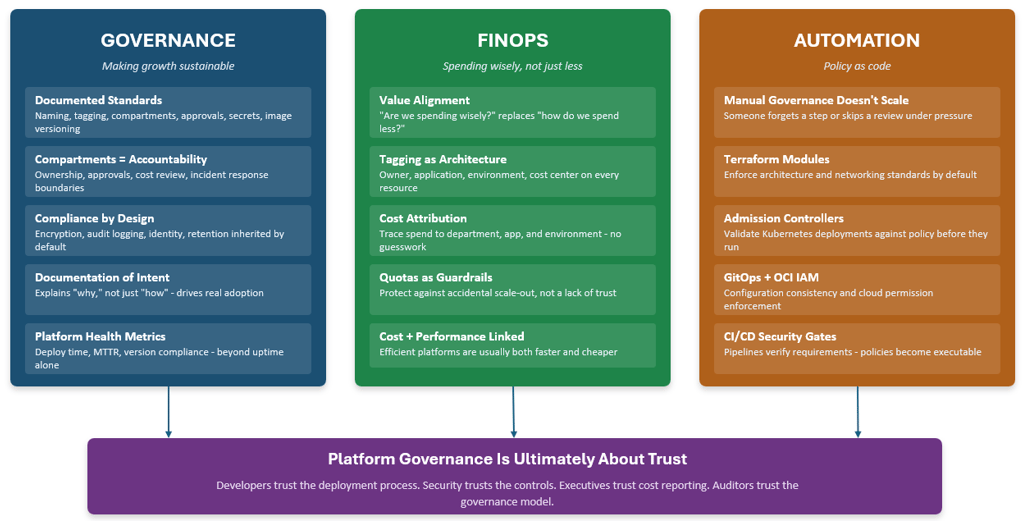
Manual governance does not scale. Eventually someone forgets a step, interprets a policy differently, or deploys infrastructure during an emergency. Embedding governance into automation produces far more consistent outcomes: Terraform modules enforce architecture standards, admission controllers validate Kubernetes deployments, OCI IAM policies define cloud permissions, GitOps ensures configuration consistency, and CI/CD pipelines verify security requirements. Notice the pattern policies stop existing only as documents and become executable. That is one of the defining characteristics of mature cloud platforms.
Quotas Should Encourage Responsible Growth
Cloud resources often appear unlimited; budgets are not. OCI Quotas provide an effective way to establish reasonable operational boundaries not because engineers cannot be trusted, but because accidental consumption happens: a misplaced autoscaling configuration, an unexpectedly large node pool, an automated deployment loop. These situations are rare, but they occur. Reasonable quotas provide another layer of protection without interfering with legitimate business growth. Good governance anticipates mistakes; it does not assume perfection.
Compliance Is Easier When It’s Designed In
Organizations operating in healthcare, banking, government, or critical infrastructure often approach Kubernetes with understandable caution, given the weight of encryption, audit logging, identity controls, data residency, access reviews, and retention policies. Rather than treating compliance as a separate project, I encourage architects to incorporate those requirements into the platform from the beginning. Applications then inherit secure defaults, and developers follow compliant deployment patterns without requiring detailed regulatory expertise. The platform quietly satisfies organizational requirements, and compliance becomes an architectural characteristic rather than a last-minute checklist.
Documentation Is Part of Governance
A lesson I have learned repeatedly is that undocumented standards rarely remain standards. Platform documentation should explain more than technical implementation it should explain architectural intent: Why are these network policies required? Why are production namespaces protected? Why are certain deployment approvals mandatory? Understanding the reasoning behind governance increases adoption far more than simply publishing rules. People generally support standards they understand.
Measure Platform Health, Not Just Platform Availability
Governance also requires meaningful measurement. I encourage platform teams to define operational indicators beyond uptime, including average deployment time, failed deployment rate, mean time to recovery, Kubernetes version compliance, the percentage of workloads using Workload Identity, the share of infrastructure managed through Terraform, resource utilization efficiency, cost per application, security policy compliance, and platform adoption across development teams. These metrics describe platform maturity in a way availability alone cannot.
Platform Governance Is Ultimately About Trust
The highest compliment a platform team can receive is not praise for technical sophistication it is trust. Developers trust the deployment process, security teams trust the platform controls, operations teams trust monitoring, executives trust cost reporting, and auditors trust governance. That trust does not emerge from documentation alone; it is earned through consistent engineering practice every automated deployment, every successful recovery, every predictable upgrade, every well-managed incident. Over time, consistency becomes credibility.
Architect’s Note
One of the strongest platform engineering teams I have worked with had surprisingly few meetings about governance not because governance was unimportant, but because most governance decisions had already been encoded into the platform. Terraform modules enforced networking standards, GitOps validated deployments, OCI IAM controlled access, and security policies executed automatically. Developers rarely requested exceptions because the default experience already aligned with organizational expectations. That changed the relationship between engineering and governance: instead of reviewing every deployment manually, the platform continuously enforced standards on behalf of the organization. Governance should become increasingly invisible not because it is less important, but because it is built into the way the platform operates every day.
Lessons from the Field: What I Would Do Differently If I Built My First OKE Platform Today
This final chapter is intentionally more personal. It reflects how my thinking has changed after years of working with enterprise customers, cloud migrations, production incidents, architecture reviews, and platform transformations.
When I built my first enterprise infrastructure platform, I thought success meant designing the most technically advanced solution possible. Every new feature seemed worth adopting; every architecture diagram became more detailed; every problem looked like an opportunity to introduce another technology. Over time, my perspective changed. The platforms that impressed me the most were not the ones using the newest technologies they were the ones nobody talked about. Developers deployed applications without opening infrastructure tickets. Security teams trusted the platform. Operations teams rarely received emergency calls. Business leaders viewed technology as an accelerator rather than a bottleneck. The architecture was not remarkable because it was complicated; it was remarkable because it quietly worked. That, in my opinion, is what enterprise architecture should strive for.
Kubernetes Doesn’t Reward Complexity
A pattern I have observed repeatedly is that engineers often mistake complexity for sophistication: three service meshes, five deployment frameworks, multiple ingress controllers, several monitoring solutions, custom admission webhooks, and dozens of Helm repositories. Everything looks impressive during demonstrations. Then the original architects leave, and suddenly nobody wants to change anything every deployment feels risky, and every upgrade becomes a project. Complexity accumulated faster than operational knowledge. I have become increasingly cautious about introducing technology without a clearly defined operational benefit, because every additional component carries a long-term maintenance cost. Architects should evaluate that cost just as carefully as they evaluate technical capability.
Technology Decisions Age Faster Than Architectural Principles
Compare Kubernetes platforms built five years apart and many technical choices will differ container runtimes change, networking evolves, observability platforms mature, CI/CD tools improve, and cloud services expand. The principles behind successful platforms remain remarkably consistent: automation over manual work, standardization over customization, security integrated from the beginning, infrastructure managed as code, and continuous improvement instead of large transformations. Those ideas hold their value regardless of which version of Kubernetes or OCI happens to be current, which is why I encourage architects to anchor their decisions in principles rather than products. Products evolve; principles provide continuity.
Don’t Build a Platform Around Today’s Team
One of the easiest mistakes to make is assuming today’s team will operate tomorrow’s platform. Organizations grow, people change roles, consultants leave, and business priorities evolve. Good architecture assumes that knowledge will eventually transfer to someone else, and that assumption changes design decisions automation becomes more valuable, documentation becomes more detailed, naming conventions become more disciplined, and operational procedures become standardized. Architectural consistency is an investment in future engineers. One day, someone you have never met will inherit your platform design with that person in mind.
Every Production Incident Is an Architecture Review
Incidents are uncomfortable, and nobody enjoys them, yet some of the most valuable architectural lessons emerge from production failures. After every major incident, I try to avoid asking only “who made the mistake?” Instead, I ask why the mistake was possible, whether automation could have prevented it, whether monitoring was insufficient, whether documentation failed, whether recovery was unnecessarily complicated, and whether the architecture made diagnosis more difficult. Blameless post-incident reviews consistently produce better platforms than assigning fault. Failures should improve architecture, not just restore service.
Architects Should Spend Time with Operations Teams
Architecture discussions often happen in meeting rooms; operations happen at two o’clock in the morning. Those experiences are very different. Whenever possible, I encourage architects to participate in operational support responding to incidents, observing deployment failures, reviewing monitoring dashboards, and participating in disaster recovery exercises. Experience teaches lessons that architecture diagrams rarely reveal. Some of my strongest design opinions came from supporting production systems rather than designing them, because operations provides feedback that architecture alone cannot.
Success Should Be Measured by Developer Experience
Enterprise platforms exist for one reason: to help development teams deliver reliable software. That objective is sometimes forgotten as organizations focus on the number of clusters, CPU utilization, infrastructure cost, and deployment frequency. Those metrics matter, but I also ask different questions: How long does it take a new developer to deploy an application? How many manual approvals are required? How quickly can a secure environment be created? How much platform knowledge is necessary before becoming productive? If developers struggle to use the platform, technical excellence becomes less meaningful. Developer experience is operational excellence viewed from another perspective.
My Ten Principles for Enterprise Kubernetes
If I had to summarize everything I have learned into a small set of architectural principles, they would look like this:
Design for Operations, Not Demonstrations.
A platform should be evaluated by how reliably it operates over time, not by how impressive it looks during a presentation.
Keep the Platform Smaller Than Your Ambition.
Avoid introducing technology simply because it is available; every component should solve a real operational problem.
Automate Every Repetitive Task.
If engineers perform the same task repeatedly, automation usually provides more long-term value than additional documentation.
Standardize Relentlessly.
Consistency reduces operational risk; exceptions should be rare and well justified.
Security Should Be Invisible to Developers.
The safest deployment process should also be the easiest one, with developers inheriting secure defaults automatically.
Infrastructure Should Always Be Reproducible.
Anything that cannot be recreated should be viewed as technical debt Infrastructure as Code is an operational philosophy, not simply a deployment strategy.
Measure Business Outcomes.
Customers care about successful transactions, not node utilization, Kubernetes versions, or deployment tools. Platform metrics should ultimately connect back to business value.
Invest in Documentation Before You Need It.
Documentation written after an incident is always less effective than documentation prepared beforehand.
Design for Change.
Requirements evolve, cloud services evolve, and businesses evolve; architectures should embrace change rather than resist it.
Simplicity Is a Competitive Advantage.
Simple platforms recover faster, cost less to operate, are easier to secure, and survive organizational change. Complexity is easy to create; simplicity requires deliberate engineering.
Looking Ahead
Oracle Cloud Infrastructure continues to evolve rapidly, Oracle Kubernetes Engine gains new capabilities every year, and platform engineering practices continue to mature. Artificial intelligence is beginning to influence operations through predictive monitoring, automated remediation, and intelligent capacity planning; infrastructure is becoming increasingly autonomous. Yet I do not believe the architect’s role is becoming less important; quite the opposite. As platforms become more capable, architectural decisions become more significant. Technology can automate implementation, but it cannot replace thoughtful design. Architects will continue to be responsible for aligning technology with business objectives, balancing competing priorities, and making decisions whose consequences may last for years. That responsibility is not shrinking it is growing.
Final Thoughts
When people ask me why I enjoy designing enterprise cloud platforms, my answer is rarely about Kubernetes, OCI, or automation; those technologies are simply tools. What I enjoy is solving problems that allow other engineers to succeed. A well-designed platform does not just host applications; it removes obstacles, reduces uncertainty, improves security without slowing delivery, and creates consistency without sacrificing flexibility. Most importantly, it allows development teams to spend more time building products and less time managing infrastructure. That is the outcome I try to achieve in every architecture I design.
If this series encourages even one architect to think less about individual cloud services and more about building platforms that remain reliable, maintainable, and adaptable over the next decade, then it has accomplished exactly what I hoped. Because great platforms are not remembered for the technologies they included, they are remembered for the problems they quietly solved.
This series reflects practical experience gained from designing, implementing, and supporting production platforms, rather than merely studying the technologies behind them. My goal is to share the architectural thinking, operational lessons, and design principles that help organizations build cloud platforms that evolve with their business.
Thank you for reading, and I hope these articles provide ideas that are useful in your own cloud journey.
© 2026. All rights reserved.
Stay Updated
Get the latest posts on OCI and cloud tech