
Oracle Kubernetes Engine (OKE) Part#2
Security, DevOps, Automation, and Day-2 Operations
Ahmed Hassan
7/5/202624 min read


When organizations first adopt Kubernetes, most of the attention goes toward getting applications running. Teams compare distributions, evaluate managed services, benchmark node performance, and debate whether containers should replace traditional virtual machines.
Those conversations are important but they don't usually determine whether a Kubernetes platform succeeds. The real challenges begin after the cluster has been running for several months.
That's when security teams ask how container images are being validated before deployment. Infrastructure engineers start planning the first Kubernetes upgrade. Development teams request self-service deployments, platform administrators begin reviewing IAM policies, and operations teams discover that nobody is entirely sure which Terraform workspace owns the production cluster.
None of these problems are unique to Oracle Kubernetes Engine (OKE). They appear on almost every Kubernetes platform, regardless of the cloud provider. The difference is that managed Kubernetes shifts the focus. Instead of spending time maintaining the control plane, platform teams can invest their effort in the operational practices that actually improve reliability.
Those activities identity management, automation, deployment pipelines, observability, governance, and operational consistency are what separate a demonstration cluster from an enterprise platform.
Operating Kubernetes Is the Real Challenge
Day-0, Day-1, and Day-2 Operations
Platform engineers often divide Kubernetes operations into three distinct stages:
Day-0 (Before the cluster exists):
Designing the network, planning IAM policies, defining infrastructure standards, preparing Terraform modules, and establishing governance.
In the first part of this series, we covered most of these architectural decisions.
Day-1 (When the cluster is deployed):
Installing applications, configuring node pools, deploying ingress controllers, adding monitoring agents, and activating CI/CD pipelines. Most teams are comfortable at this stage because it's highly visible; new workloads appear quickly, and progress is easy to measure.
Day-2 (The long-term lifecycle):
Upgrading Kubernetes versions, rotating credentials, managing IAM policies, scaling clusters, responding to incidents, monitoring workloads, optimizing cloud costs, maintaining deployment pipelines, and supporting development teams.
This final phase lasts for years. Ironically, these operational activities receive far less attention during project planning, even though they consume most of the platform team's time over the lifetime of the environment. When reviewing Kubernetes platforms that have been running successfully for several years, the common factor isn't the technology; it's operational discipline.
A Kubernetes Platform Is a Product
One shift in thinking has transformed how many organizations manage Kubernetes: Instead of viewing the cluster as infrastructure, successful teams increasingly treat it as an internal product.
Infrastructure is something engineers maintain; products are something users consume. In this model, the users are application teams. The platform team becomes responsible for providing a reliable, secure, and well-documented Kubernetes service that developers can trust.
Developers shouldn't need to understand OCI networking to deploy an application.
They shouldn't have to request firewall changes every time a namespace is created.
They shouldn't spend days figuring out which container registry to use or how secrets are managed.
A well-designed platform hides much of that complexity behind consistent automation. If a new development team joins tomorrow, they should be able to deploy their first production-ready application in hours, not weeks.
Identity Before Infrastructure
Identity architecture deserves far more attention than compute architecture. Compute resources are relatively easy to replace, but identity mistakes have a habit of surviving for years.
Many organizations initially grant broad administrative permissions simply to accelerate deployment. It feels harmless during the first few weeks of a project. Eventually, however, dozens of engineers share overly privileged accounts, automation pipelines accumulate unnecessary permissions, and nobody is entirely certain which service can access which cloud resources. Cleaning up that environment later is considerably more difficult than designing it correctly from the beginning.
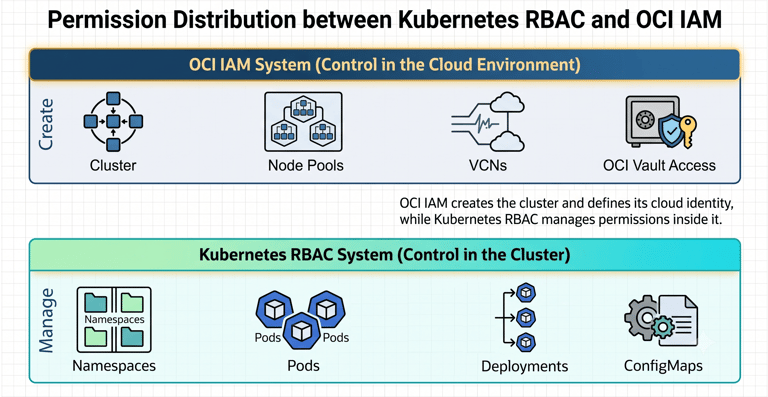
OCI IAM and Kubernetes RBAC Serve Different Purposes
A common source of confusion is the relationship between Oracle Cloud IAM and Kubernetes Role-Based Access Control (RBAC). Although both deal with permissions, they solve entirely different problems:
OCI IAM controls the cloud
It determines who can interact with Oracle Cloud resources, such as:
creating clusters.
managing node pools.
provisioning load balancers.
accessing Object Storage.
reading secrets from OCI Vault.
Kubernetes RBAC controls Kubernetes:
It governs what users and applications can do inside the cluster itself, such as:
creating namespaces.
deploying workloads.
viewing logs.
managing ConfigMaps.
updating Deployments.
The two systems complement each other; neither replaces the other. Trying to solve both problems with a single permission model usually leads to unnecessary complexity.
Least Privilege Is Easier to Design Than to Recover
Almost every organization agrees with the principle of least privilege, yet fewer organizations consistently implement it. This is not because the concept is difficult, but because broad permissions are convenient.
Early in a project, granting Administrator access to everyone feels like a shortcut. Six months later, nobody wants to remove those permissions because every automation pipeline depends on them. Start restrictive and expand permissions only when a genuine requirement appears. The opposite approach rarely ends well. Platform teams should periodically review IAM policies, not only after security audits but as part of normal operational maintenance. Identity is infrastructure treat it accordingly.
Identity Domains Simplify Enterprise Operations
As OCI environments grow, Identity Domains become increasingly valuable. They provide centralized identity management while integrating with enterprise identity providers such as Microsoft Entra ID, Oracle Identity Cloud Service, and other SAML or OIDC-compliant platforms. From a platform engineering perspective, this enables:
Single Sign-On (SSO) for administrators.
Consistent user lifecycle management.
Multi-factor authentication (MFA).
Federation with corporate directories.
Simplified onboarding and offboarding.
Rather than managing users independently within OCI, organizations can align cloud access with existing corporate identity processes. This reduces administrative overhead while improving governance and compliance.
Securing the Software Supply Chain
For years, infrastructure security focused almost exclusively on servers. Administrators hardened operating systems, patched vulnerabilities, configured firewalls, and monitored network traffic. If the servers were secure, most organizations considered the platform secure.
Containers changed that equation. Today, the application itself often arrives as a prebuilt image assembled from dozens sometimes hundreds of open-source components. A single container image might contain libraries written by different communities, packaged by different maintainers, and updated on entirely different schedules. That means your production deployment isn't just running your code; it's also running every dependency your development team included, intentionally or otherwise.
From an architect's perspective, this shifts the security conversation. Instead of asking, "Is the server secure?", we now need to ask:
Where did this container image come from?
Who built it?
Has it been modified?
Has it been scanned?
Which version is running in production?
Can we reproduce it six months from now?
These questions form the foundation of a secure software supply chain.
Your Container Registry Is More Than Storage
Many teams initially think of a container registry as a basic file repository:
build an image ====> push it===> deploy it.
In reality, the registry is one of the most sensitive components in your Kubernetes platform. Every deployment begins there, every rollback depends on it, and every production release ultimately trusts what's stored inside it. The registry must be treated as part of your security boundary rather than simply a convenient storage bucket.
Why I Prefer Oracle Container Registry (OCIR) for OCI Workloads
Whenever applications are primarily hosted on Oracle Cloud Infrastructure, my default recommendation is Oracle Cloud Infrastructure Registry (OCIR). You can easily integrate Docker Hub, GitHub Container Registry, Azure Container Registry, or Amazon ECR, but OCIR provides superior operational consistency.
Authentication uses native OCI Identity.
Permissions follow OCI IAM policies.
Traffic remains inside the Oracle network when accessed through a Service Gateway.
Auditing integrates cleanly with OCI Audit.
Image management becomes an integrated piece of your cloud governance model rather than a standalone, disconnected system. Reducing the number of fragmented security models makes enterprise environments far easier to operate.
The Registry Should Never Become Your Build Server
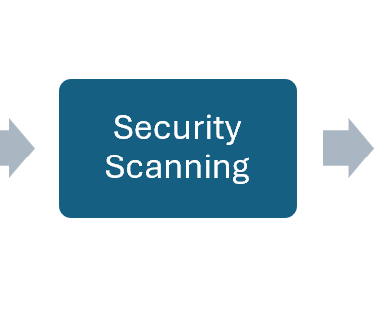
One architectural mistake I occasionally encounter is treating the container registry as part of the build process. The build pipeline should produce immutable images; the registry should store them. Those are separate responsibilities. A healthy software delivery pipeline follows a predictable, unidirectional sequence:
Nobody should modify images after they are pushed, images should never be rebuilt directly inside the registry, and production images must never be manually edited. Immutability is one of the strongest security controls available in modern software delivery.
Every Image Should Be Traceable
Can you identify exactly which Git commit produced the image currently running in production? If the answer is no, incident investigations become significantly more difficult. Every production image should be directly traceable back to its:
Source repository and Commit ID
Build pipeline and timestamp
Builder identity
Security scan results
Modern CI/CD platforms make this relatively straightforward. The important part is deciding that traceability is an absolute requirement rather than a nice-to-have feature.
Stop Using 'latest'
If there's one habit I try to eliminate early in Kubernetes projects, it's relying on the 'latest' tag. It seems convenient, but it is one of the easiest ways to introduce deployment uncertainty.
Imagine investigating an issue in production where a deployment references 'mycompany/api:latest'. Which version is that? The one from yesterday? This morning? Five minutes ago? Nobody knows without digging into image digests.
Compare that with 'customer-api:2.4.18' or 'customer-api:2026.07.14-1052'. Explicit versioning brings immediate clarity. Rollbacks become predictable, audit trails improve, and automation becomes robust. The 'latest' tag is useful during local experimentation, but it rarely belongs in a production environment.
Image Scanning Should Be Automatic
Container security shouldn't depend on someone remembering to run a vulnerability scanner before releasing software. Scanning needs to be built natively into the pipeline. Every image entering the registry should be evaluated automatically for known CVEs, outdated libraries, unsupported packages, high-risk dependencies, and base operating system vulnerabilities.
Finding vulnerabilities is the easy part; preventing vulnerable software from reaching production is where governance matters. I frequently recommend defining clear promotion rules:
Critical vulnerabilities automatically block deployment.
High vulnerabilities require formal architectural approval.
Medium vulnerabilities trigger automated warnings and log tickets.
Low vulnerabilities are documented and reviewed during periodic maintenance cycles.
Security policies become significantly more effective when they are predictable and automated.
Secrets Don't Belong in Container Images
This sounds obvious, yet it still happens. I've reviewed production images that contained database passwords, cloud credentials, API keys, private certificates, and SSH keys. Sometimes these values were hidden in configuration files, embedded as environment variables during the image build, or committed directly into Git repositories.
All of these approaches create severe long-term risk. Container images should remain completely portable and generic, while secrets must remain external.
OCI Vault Changes the Conversation
Oracle Cloud Infrastructure Vault provides a much cleaner, decentralized model. Instead of embedding sensitive values inside applications, secrets are managed centrally and accessed securely when required. This provides stark advantages:
Credentials can be rotated without rebuilding or redeploying container images.
Applications receive only the explicit secrets they require at runtime.
Audit logs record every single access event.
Security teams manage secret lifecycles independently from development teams.
Application images become entirely identical across environments. Development, Testing, Staging, and Production share the exact same image, and only the injected secrets differ.
Workload Identity Is Better Than API Keys
Without Workload Identity, applications typically authenticate using stored long-lived credentials. Someone creates an OCI API key, stores it as a traditional Kubernetes Secret, and the application retrieves it during startup. Eventually, the key expires, somebody forgets to rotate it, or worse, nobody remembers which applications still depend on it.
Workload Identity eliminates most of this operational burden. Applications authenticate through Kubernetes Service Accounts mapped directly to OCI IAM permissions via web token federation. There are no embedded API keys, no manual rotations, and no dangerous credential distribution. From a platform engineering perspective, this is one of the most valuable security improvements available in modern OCI environments.
Security Should Be Invisible to Developers
Developers shouldn't spend their time becoming security infrastructure experts. Instead, the platform should make secure behavior the easiest behavior.
When a new application is deployed, the platform should quietly enforce organizational standards: images are scanned automatically, secrets are pulled dynamically from Vault, authentication uses Workload Identity, registry permissions follow IAM, and audit logging is enabled by default. When security depends on individual developers remembering dozens of manual steps, consistency inevitably suffers. Good platforms reduce opportunities for human error by embedding security directly into the delivery fabric.
Building a Deployment Platform Instead of a Deployment Pipeline
When I meet teams that are just beginning their Kubernetes journey, one question almost always comes up: "Which CI/CD tool should we use?" They list GitHub Actions, OCI DevOps, Azure DevOps, Jenkins, GitLab CI, Argo CD, Flux, Terraform, and Helm.
It's a reasonable question, but it's the wrong place to start. The real question isn't which tool you choose; it's whether you're designing a deployment pipeline or building a deployment platform.
A deployment pipeline gets a single application into production. A deployment platform allows dozens or even hundreds of development teams to deploy software consistently without every team inventing its own process. This distinction becomes increasingly critical as Kubernetes adoption expands across an organization.
Automation Should Remove Decisions, Not Just Manual Work
Many people describe automation as a way to eliminate repetitive tasks. Good automation does more: it removes unnecessary decisions. Consider a developer deploying a new microservice. If they need to decide:
Which Kubernetes namespace should I use?
Which registry should I push to?
Which IAM policy do I need?
Which ingress controller should I configure?
Which Helm chart version is approved?
Which monitoring annotations should I add?
then the platform is still asking developers to make infrastructure decisions. Instead, those decisions should already be embedded into the platform. The deployment process becomes predictable because the platform provides sensible, pre-configured defaults. Developers focus on code; the platform quietly handles the operational standards.
Infrastructure as Code Is the Foundation
Long before an application reaches Kubernetes, the infrastructure supporting that application should already exist as code which in OCI environments generally means Terraform. Infrastructure changes deserve the same engineering discipline as application code. When every VCN, subnet, node pool, route table, IAM policy, and load balancer exists in version control, several things improve immediately:
Infrastructure becomes reviewable via pull requests.
Changes become entirely auditable.
Disaster recovery becomes a repeatable script.
Environments become perfectly consistent.
Rebuilding an environment becomes an engineering exercise rather than a documentation review exercise. Documentation explains what should exist; Infrastructure as Code creates what should exist.
Why I Prefer OCI Resource Manager
Running Terraform locally works well for small projects, but large organizations quickly encounter operational hurdles: Where should state files live? Who can execute Terraform? How are credentials managed? How are changes approved?
OCI Resource Manager answers many of these operational concerns by providing a managed Terraform execution environment inside Oracle Cloud. Rather than maintaining dedicated, high-maintenance Terraform management servers, platform teams can run infrastructure deployments through a service that integrates naturally with OCI Identity, IAM, Audit, and Resource Manager Jobs. Whenever possible, I prefer reducing external infrastructure rather than introducing more of it.
CI Builds Software. CD Delivers Confidence.
Continuous Integration and Continuous Delivery are complementary, but they solve entirely different problems:
Continuous Integration (CI):
validates the software. It answers: Does the application compile? Do the tests pass? Is the container image valid? Did security scanning succeed?
Continuous Delivery (CD):
validates operational readiness. It asks: Can this software be deployed safely into the target environment without disruption?
A mature delivery process recognizes that both stages are equally important and keeps their boundaries distinct.
OCI DevOps Has Matured Significantly
Oracle DevOps has evolved considerably over the past few years. Earlier OCI customers often relied on Jenkins or Azure DevOps because Oracle's native DevOps capabilities were still developing. Today, OCI DevOps provides a comprehensive, enterprise-ready service handling build pipelines, deployment pipelines, artifact management, approval stages, native OCIR integration, logging, and IAM-bound authentication.
For organizations already invested in OCI, keeping the delivery platform inside the same cloud ecosystem simplifies governance and operational management. That said, I don't believe every organization should automatically replace their existing CI/CD platforms. Technology decisions should respect organizational maturity. If a company already operates a stable Azure DevOps or GitHub Actions environment supporting hundreds of applications, rebuilding that ecosystem simply because OCI DevOps exists rarely delivers enough business value to justify the migration. Integration is often a better strategy than wholesale replacement.
GitHub Actions and Azure DevOps
GitHub Actions fundamentally changed how developers think about automation by making it part of the repository itself, allowing workflows to be reviewed alongside application code. For smaller teams, this convenience is often more than sufficient. For larger enterprises, however, centralized platform engineering practices eventually become more important than repository-level convenience to enforce governance.
Similarly, many Oracle customers assume moving workloads to OCI requires abandoning Azure DevOps. In practice, that's rarely true. I've worked with organizations that successfully deploy OCI infrastructure using Azure DevOps while managing identity through OCI IAM and storing images in OCIR. Cloud migration does not mandate DevOps migration. Preserving stable, mature operational processes is often the best architectural decision.
Helm Isn't Just a Packaging Tool
Over time, Helm has evolved into something much more critical than an installation utility: a Helm chart captures and executables operational knowledge. It codifies resource requests, health checks, configuration values, dependencies, network settings, and deployment strategies. Instead of documenting how an application should be deployed, the deployment logic becomes versioned, executable code.
Why Every Platform Needs Standards
Allowing every team to create its own deployment conventions different labels, health probes, logging formats, ingress annotations, and resource limits initially feels empowering. Over time, it turns into crippling operational debt.
Successful platform teams provide highly opinionated templates. This is not because developers lack expertise, but because consistency reduces operational complexity. When every application follows similar deployment patterns, monitoring becomes simpler, troubleshooting accelerates, automation becomes highly reusable, and platform upgrades carry substantially less risk. Consistency scales far better than individual customization.
GitOps Changed the Operational Model
Perhaps the most significant operational shift in Kubernetes over the past several years has been the adoption of GitOps. Traditional deployment pipelines push changes into Kubernetes. GitOps reverses that relationship: instead of CI systems modifying clusters directly, an agent inside the Kubernetes cluster continuously reconciles its own live state against a Git repository.
Git becomes the absolute single source of truth for every deployment, rollback, and configuration change across every environment. This provides powerful operational advantages: infrastructure becomes transparently auditable, rollbacks become predictable Git reverts, and unauthorized configuration drift is automatically visualized and corrected.
Why I Like Argo CD
Among the available GitOps platforms, Argo CD has become my preferred choice for Kubernetes environments because it embraces Kubernetes' declarative model exceptionally well. Argo CD continuously compares the desired state stored in Git with the actual state running inside the cluster.
If differences appear, they are immediately flagged visually. Depending on policy, Argo can either alert administrators or automatically overwrite and sync the cluster back to the intended configuration. This simple capability fundamentally changes platform operations: configuration drift stops being a hidden, insidious problem and becomes a highly observable event.
Observability: Knowing What's Happening Before Your Customers Do
One of the first production incidents I participated in early in my cloud career lasted nearly four hours. The application wasn't down, the Kubernetes cluster wasn't unhealthy, the database wasn't overloaded, and the infrastructure metrics looked perfectly normal.
The problem turned out to be a single backend service that had gradually become slower over several days. Each request added only a few milliseconds of latency, so nobody noticed. Individually, those delays seemed insignificant. Together, they eventually caused request queues to grow, API timeouts to cascade, and users to perceive the application as "randomly slow."
The technology wasn't the problem; visibility was. Monitoring tells you that something is wrong; observability helps you understand why. Those are not the same thing.
Monitoring Is Only One Piece of the Puzzle
Many organizations believe they're "covered" because CPU utilization and memory usage appear green on a dashboard. Those metrics certainly matter, but they are among the least interesting indicators of application health. I've seen production environments where every infrastructure metric remained comfortably within expected thresholds while users were entirely unable to complete transactions.
Customers don't experience CPU utilization; they experience response times, error messages, failed payments, slow searches, and incomplete uploads. Infrastructure metrics describe servers; observability describes systems.
The Three Pillars and Beyond
Observability is traditionally introduced through three pillars: Metrics, Logs, and Traces. While that model remains useful, it can unintentionally encourage teams to treat each area as an isolated silo. A more practical way to evaluate observability is to ask: Can I answer any arbitrary operational question about my platform using the data I've collected? If the data source can answer the question, the specific pillar becomes secondary.
Metrics Tell You That Something Changed:
CPU, memory, disk throughput, pod restarts, request rates, latency, and error percentages reveal trends that would otherwise remain invisible. They are excellent for identifying abnormal behavior, but usually insufficient for explaining it.
Logs Explain Individual Events:
Logs provide context by describing specific events (e.g., a failed database connection, a rejected authentication request, a timeout, or a Kubernetes scheduling failure). The challenge here is scale. Modern Kubernetes environments generate massive amounts of log data; collecting logs is easy, but finding the relevant five lines among millions of entries requires centralized tools.
Tracing Reveals Distributed Journeys: A single customer request in a modern cloud-native system may involve an API Gateway, authentication services, payment services, inventory systems, caches, and database queues. Distributed tracing tracks the entire request journey across the platform. Instead of asking, "Which service is unhealthy?", tracing allows us to ask, "Where did this specific request spend most of its time?"
OCI Logging and Logging Analytics
Oracle Cloud Infrastructure includes a managed Logging service that integrates naturally with OKE, allowing administrators to centralize logs from application workloads, load balancers, audit events, VCN Flow Logs, and OKE control plane events into a common interface.
To complement this, OCI Logging Analytics applies machine learning techniques to identify anomalies, recurring behaviors, and operational trends across billions of log entries that would be impossible to discover manually. It acts as a force multiplier, allowing engineers to begin incident investigations with meaningful patterns already identified rather than wasting hours filtering raw log files.
Prometheus and Grafana: The Kubernetes Standards
While OCI provides native monitoring tools, Prometheus remains the dominant metrics platform within Kubernetes because it understands the cluster's dynamic nature natively. Pods appear and disappear constantly, services scale automatically, and node pools fluctuate. Prometheus discovers these workloads automatically and updates its monitoring targets without requiring administrators to maintain static server lists.
Grafana turns this data into meaningful visualizations. A critical recommendation when building dashboards is to design them around services rather than infrastructure. Developers care about applications, operations teams care about platform health, and executives care about customer impact. Each audience benefits from different dashboards; trying to satisfy everyone with a single display usually satisfies nobody.
Alert Fatigue Is Real
One of the fastest ways to make engineers ignore monitoring systems is generating too many alerts. I've inherited environments producing thousands of automated notifications every day. Most were technically correct, but almost none required immediate action. Eventually, engineers stopped paying attention a dangerous place for any production organization to be.
Alerts should indicate conditions that require explicit action, not merely interesting observations. A useful litmus test when designing an alert is: "If this alert fires at three o'clock in the morning, should someone actually wake up?" If the answer is no, it belongs on a dashboard or an email digest, not in the paging system.
Measure the User Experience via Service Level Objectives (SLOs)
Customers don't care which Kubernetes node handled their request. Observability should reflect this by tracking customer journeys (login success rates, checkout completion times, API latency) over raw infrastructure components.
As platforms mature, monitoring evolves into reliability engineering through Service Level Objectives (SLOs). Rather than asking a vague question like "Is everything healthy?", organizations define precise, measurable expectations (e.g., $99.95\%$ API availability, checkout response times below 500ms). These objectives create a shared, objective language between engineering teams and business stakeholders, anchoring technical decisions directly to business outcomes.
Day-2 Operations: Running Kubernetes Like an Enterprise Platform
When organizations first deploy Kubernetes, success is measured by whether the application deployed successfully. Six months later, the questions shift entirely:
Can we upgrade without downtime?
Why did cloud costs increase by 30% this month?
Which applications are consuming the most resources?
Can we recover this cluster if an entire region becomes unavailable?
Who approved this configuration change?
These questions have very little to do with Kubernetes features and everything to do with operating a platform. That is what Day-2 Operations is all about.
Clusters Should Be Boring
Boring infrastructure is a massive compliment. If engineers are constantly talking about the Kubernetes platform, something is probably wrong. Healthy platforms fade into the background: developers deploy applications, monitoring works, backups complete, upgrades happen, and certificates rotate seamlessly. Platform engineering isn't about building exciting infrastructure; it's about making infrastructure completely predictable.
Kubernetes Upgrades Are a Process, Not an Event
Upgrading Kubernetes does not simply mean selecting a newer version from the OCI Console. Technically, that's true; operationally, it's only the final step. Before every production upgrade, several dependencies must be rigorously validated:
Are all deployed applications compatible with the target Kubernetes API version?
Have deprecated APIs been fully removed from Helm charts and manifests?
Are CSI drivers, Ingress Controllers, and admission controllers certified for the new version?
Will monitoring and logging agents continue to function?
Has the cluster rollback or node-drain process been rehearsed?
The upgrade itself usually takes less time than validating the surrounding ecosystem. Think of upgrades as engineering projects rather than simple maintenance toggles.
Upgrade Small, Upgrade Often
Organizations sometimes postpone upgrades because the platform appears stable. Eventually, they discover they are several major Kubernetes releases behind. At that point, upgrading becomes a high-risk operation: multiple deprecated APIs disappear simultaneously, application teams haven't tested against recent versions, and operational knowledge fades.
Upgrade regularly. Small upgrades carry substantially smaller risk, teams remain familiar with the process, automation continues to evolve, and operational confidence increases. The best Kubernetes upgrades are the ones nobody remembers a month later.
Node Pools Should Be Disposable
Worker nodes must be treated as temporary, disposable infrastructure. Early in the Kubernetes era, engineers treated worker nodes much like traditional virtual machines logging into them, installing custom troubleshooting utilities, modifying local configuration files, and collecting ad-hoc scripts. This creates configuration drift and infrastructure that cannot easily be replaced.
If deleting a random worker node causes panic, your platform isn't production-ready. Applications persist; individual infrastructure nodes do not. This mindset forces robust architecture: applications must use replication, respect Pod Disruption Budgets, and rely on external persistent storage.
Autoscaling Is More Than Adding Capacity
Cluster Autoscaler often receives attention because it's easy to demonstrate: traffic increases, new worker nodes appear, and capacity expands. The more critical operational question is: When shouldn't the cluster scale?
Uncontrolled autoscaling can easily mask poorly designed applications. A memory leak or highly inefficient code doesn't disappear because more nodes are thrown at it; it just makes your cloud bill more expensive. Autoscaling should absorb legitimate, elastic workload variation not compensate for architectural flaws. Investigate abnormal application behavior before automatically increasing infrastructure limits.
Cost Optimization Starts With Visibility
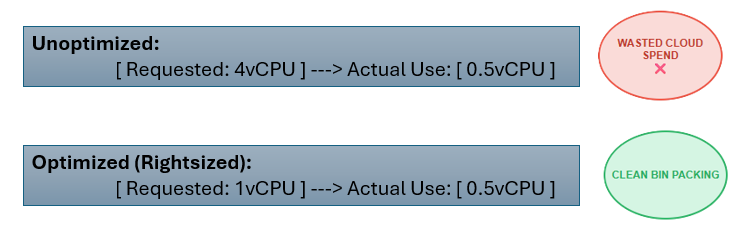
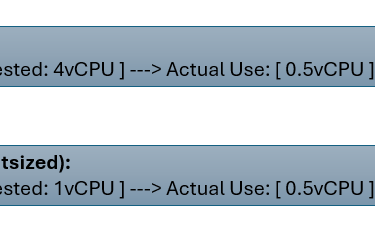
Kubernetes does not automatically optimize infrastructure utilization. It schedules workloads strictly according to the information it receives via deployment manifests. If applications request excessive CPU or memory, Kubernetes assumes those requests are justified, leading to half-empty nodes, poor bin packing, and quietly accumulating cloud costs.
Platform teams must regularly audit and compare requested resources against actual real-world consumption. The gaps are often striking; it is common to find idle development workloads requesting four times more memory than they ever actually utilize. Cost optimization isn't about buying cheaper infrastructure; it's about rightsizing existing allocations and using what you pay for effectively.
Multi-Environment Consistency Matters
Every enterprise runs multiple environments: Development, Testing, Staging, and Production. The challenge is preventing them from becoming fundamentally different. If production uses different Helm charts, distinct IAM policies, unique networking rules, and separate deployment paths than staging, engineering confidence collapses. Every production deployment becomes an anxiety-inducing leap of faith. Promote identical deployment artifacts through progressively stricter environments; the software configuration changes via environment variables, but the deployment platform manifests should not.
Disaster Recovery Begins Long Before Disaster
Many disaster recovery plans exist primarily as paper compliance documents that have never been verified. If a recovery plan has never been practiced, it remains entirely theoretical. For Kubernetes platforms, a verified recovery plan must include automated rehearsals for:
Recreating core cloud infrastructure through Terraform.
Validating automated backups and restoring persistent volumes.
Restoring secrets from OCI Vault and resetting DNS failover paths.
Validating database dependencies and executing application smoke tests.
Governance and Documentation
Developers occasionally worry that governance introduces unnecessary bureaucracy. Poor governance certainly can, but good governance does the opposite: it removes ambiguity. When expectations around registries, secret management, labeling, and monitoring standards are consistent, teams move significantly faster because they don't have to reinvent wheels.
To support this, prioritize internal operational documentation. Organizations produce extensive application documentation, but platform runbooks are often left thin. Ensure clear, step-by-step guides exist for cluster upgrades, node replacement, certificate rotation, and GitOps workflows. Operational documentation preserves institutional knowledge long after individual architects move into new roles.
What Enterprise Kubernetes Has Taught Me
Successful Kubernetes platforms are rarely defined by technical choices alone; they are defined by operational discipline. The technology eventually becomes routine, but your operating model determines whether the platform remains healthy and scalable three years down the road.
Kubernetes Is Not Your Product
One mistake I've seen repeatedly is organizations becoming so focused on Kubernetes that they forget why they adopted it in the first place. Customers don't buy Kubernetes, business users don't log into it, and executives don't measure it. Applications create business value; Kubernetes simply provides the environment where those applications run.
This distinction matters because it influences architectural priorities. If platform engineers spend weeks debating minor infrastructure configurations while application teams struggle to release basic software, something is fundamentally out of balance. The platform exists to accelerate delivery, not to become another bottleneck that every project must negotiate. One of the healthiest signs of a mature platform is that developers rarely have to think about it.
Consistency Beats Cleverness
Early in my career, I admired highly customized environments with unique scripts, specialized automation, and handcrafted deployment logic. It felt like engineering excellence, but it was actually severe engineering debt. Every customization introduced an undocumented exception and a dependency that couldn't scale.
Choose consistency over creativity. Standard node pools, standard Helm templates, standard monitoring configurations, and standard deployment workflows make a platform easier to operate. The most impressive platform isn't the one with the most experimental features; it's the one that every engineer on call thoroughly understands.
Platform Teams Should Think Like Product Teams
The discipline of Platform Engineering treats internal developers as customers. Like any successful product team, platform engineers must focus heavily on:
The developer experience (DX) and ease of onboarding.
Clear, self-service technical documentation.
Platform reliability and backward compatibility.
Gathering regular user feedback to eliminate friction.
If developers repeatedly need manual platform support or tickets to deploy basic software, the platform itself needs improvement. The goal isn't reducing developer responsibility; it's removing unnecessary cognitive load.
Every Manual Step Eventually Becomes an Incident
Whenever you discover a manual operational process, ask two questions: Why hasn't this been automated? and What happens if the single person responsible is unavailable during an emergency?
Sometimes manual steps are unavoidable during initial setups, but they frequently morph into organizational habits. Automation isn't valuable simply because engineers dislike repetitive work; it's valuable because people are inherently inconsistent, while automation is not. Recreate this absolute expectation across your platform: nothing should exist in production that cannot be systematically recreated from version control.
Don't Chase Every New Kubernetes Feature
The cloud-native ecosystem evolves at a dizzying pace, introducing new APIs, service meshes, controllers, and observability projects every quarter. It's tempting to believe mature platforms adopt everything immediately. In reality, mature platforms practice deliberate restraint.
Before introducing any shiny new technology into production, ask: "Which explicit operational problem does this solve?" If the answer isn't starkly clear, the technology represents unnecessary complexity. Innovation has immense value, but so does architectural restraint.
OCI Has Matured Into a Serious Enterprise Platform
When Oracle first introduced Oracle Kubernetes Engine (OKE), many organizations approached it cautiously while the managed cloud landscape was still taking shape. Today, the conversation is entirely different. OKE has matured into a reliable platform capable of supporting demanding, high-scale enterprise workloads.
The control plane is rock-solid, networking integrates naturally with native OCI VCNs, identity services are deeply mature, and Oracle has steadily focused on reducing the operational burden rather than simply piling on feature fluff. Enterprise platforms succeed when they become easier to safely operate day after day.
Summary: Designing an OKE Platform Today
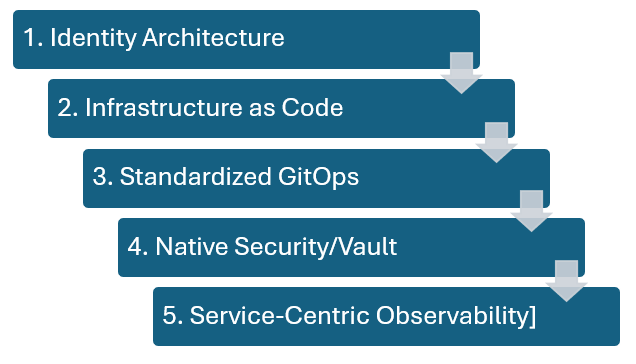
If I were architecting an OKE platform from scratch today, my execution priorities would align tightly with these core engineering principles:
Architecture Over Tooling:
Establish robust OCI IAM identity domains, least-privilege guardrails, and network boundaries before provisioning a single compute resource.
Pure Infrastructure as Code:
Build everything through version-controlled Terraform modules executed via OCI Resource Manager to completely banish manual click-ops.
Standardized Delivery Fabric:
Implement Helm templates and declarative GitOps via Argo CD to ensure deployment patterns are unified and immune to configuration drift.
Invisible Embedded Security:
Integrate OCI Vault and Workload Identity from day one so that applications never touch long-lived API keys or embedded image secrets.
Service-Centric Observability:
Treat telemetry as a core platform feature rather than an afterthought, focusing dashboards and alerts on user-facing SLOs rather than raw server metrics.
Design for the Future Operator:
Optimize every architectural decision for the engineers who will be operating and patching the platform two years from now, rather than just the engineers trying to rush the first application live next week.
Conclusion
Reflecting on the lifecycle of enterprise cloud platforms, long-term success rarely comes down to isolated technical features. Instead, it is defined by sustained operational discipline. The following core realities map out the essential lessons learned across identity architecture, software security, continuous delivery, and systems observability.
1. Identity as the Core Blueprint
One of the biggest mistakes I see isn't technical it's organizational. Companies often spend months choosing the right Kubernetes version, the ideal node shape, or the perfect networking model. Meanwhile, identity is treated as something that can be "cleaned up later".
In practice, I've found the opposite to be true. Upgrading Kubernetes is a routine operational task. Redesigning an identity model after hundreds of users, service accounts, and automation pipelines depend on it is a major project. If you invest extra time in one area at the beginning of your Kubernetes journey, let it be identity. It's one of the few architectural decisions that becomes progressively harder to change as the platform grows.
2. The Human Element in Platform Security
lesson I've learned from production environments is that security failures rarely stem from sophisticated, state-sponsored attacks against Kubernetes itself. More often, they're the result of ordinary operational shortcuts: a shared administrator account that was never retired, an API key copied between projects because it "just worked," a container image rebuilt manually during an emergency and never properly versioned, or an overlooked vulnerability in a base image that quietly remained in production for months.
None of these issues are unique to Oracle Cloud or Kubernetes; they're symptoms of weak operational discipline. The encouraging part is that they're also entirely preventable. When security is designed into the platform from image creation to deployment and runtime it becomes part of the engineering process rather than a last-minute checklist before release.
3. Tooling Pragmatism and Consistency
lesson I've learned after reviewing several enterprise Kubernetes environments is that organizations rarely fail because they chose the "wrong" CI/CD product. I've seen highly successful platforms built with OCI DevOps, Azure DevOps, GitHub Actions, GitLab CI, and even well-maintained Jenkins environments.
What consistently distinguishes mature platforms isn't the tooling it's the consistency behind the tooling. Every application follows the same deployment standards, infrastructure is version-controlled, changes are formally reviewed, secrets are managed centrally, and rollbacks are entirely predictable. When those principles are in place, changing CI/CD tools becomes a manageable engineering project. Without them, replacing one tool with another rarely solves the underlying operational chaos.
4. Recognizing Cascading Patterns in Observability
lesson I've learned over the years is that production incidents rarely begin with a dramatic, single failure. More often, they're a chain of small, creeping events that nobody connected in time: a slightly slower database query, a growing message queue, an increase in retry attempts, a certificate approaching expiration, or a deployment that introduced a subtle memory leak.
Individually, none of these events seem particularly concerning. Together, they eventually lock up a system and cause an outage. Good observability isn't about collecting more telemetry; it's about helping engineers recognize these cascading patterns before your customers do.

© 2026. All rights reserved.
Stay Updated
Get the latest posts on OCI and cloud tech