
Oracle Kubernetes Engine (OKE) Part#1
A Complete Architecture Guide for Enterprise Kubernetes on Oracle Cloud
Ahmed Hassan
7/3/202618 min read
Every cloud provider offers a managed Kubernetes service, but they don't all solve the same problem in the same way. Some focus primarily on simplifying Kubernetes installation. Others emphasize scalability or integration with their broader cloud ecosystem. Oracle Kubernetes Engine (OKE) strikes a different balance. It removes much of the operational complexity of running Kubernetes while still giving infrastructure teams full control over networking, security, identity, storage, and compute.
That distinction becomes increasingly important as organizations move beyond proof-of-concept environments. Running a handful of containers is relatively straightforward. Operating hundreds of microservices across multiple environments, maintaining security, upgrading clusters without disrupting workloads, and controlling cloud costs are entirely different challenges.
Many organizations evaluating Oracle Cloud Infrastructure tend to underestimate OKE. They often compare it only with other managed Kubernetes offerings and conclude that Kubernetes is Kubernetes. In practice, the surrounding cloud services, operational model, and architectural flexibility have a much greater impact on day-to-day operations than the Kubernetes distribution itself.
This guide explores Oracle Kubernetes Engine from an architect's perspective rather than a product overview. Instead of repeating documentation, we'll examine how OKE is designed, why Oracle made certain architectural decisions, and how those decisions influence real production environments.
Why Enterprises Continue Choosing Kubernetes
Containers solved one problem: packaging applications consistently across environments. Kubernetes solved another: operating those containers reliably at scale.
Modern enterprise applications rarely consist of a single monolithic application anymore. A typical business platform might include dozens or even hundreds of independently deployed services. Those services need scheduling, scaling, networking, health monitoring, service discovery, rolling updates, and fault recovery. Managing all of that manually quickly becomes impossible.
Kubernetes provides a standardized orchestration layer that automates much of this operational complexity. Regardless of where applications run on-premises, Oracle Cloud, Azure, AWS, or Google Cloud, the Kubernetes API remains largely consistent. This portability has become one of Kubernetes' greatest strengths. For organizations adopting hybrid cloud strategies or planning future migrations, Kubernetes reduces infrastructure dependency while allowing development teams to focus on application delivery rather than server administration.
Where Oracle Kubernetes Engine Fits
Oracle Kubernetes Engine isn't Oracle's version of Kubernetes. It is Oracle's managed implementation of upstream Kubernetes running natively on Oracle Cloud Infrastructure.
That distinction matters. OKE doesn't introduce a proprietary orchestration platform or require developers to learn Oracle-specific deployment concepts. Applications built for standard Kubernetes can generally run on OKE with minimal modification.
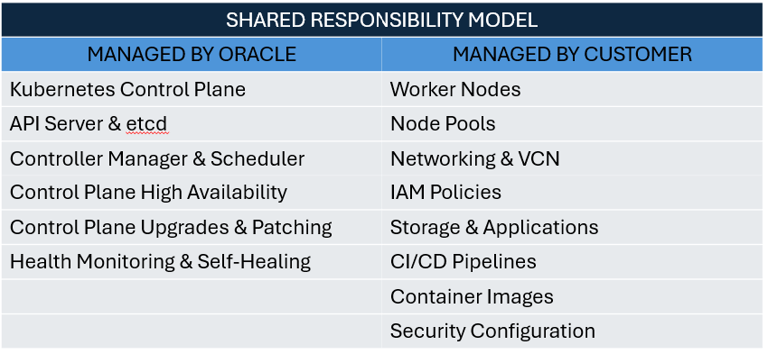
Oracle manages the Kubernetes control plane while customers retain ownership of the components that directly affect application performance and security. This shared responsibility model significantly reduces operational overhead without limiting architectural flexibility. Think of OKE as delegating the repetitive infrastructure work to Oracle while allowing engineering teams to retain control over everything that differentiates their applications.
Understanding the Shared Responsibility Model
One misconception frequently encountered is the belief that "managed Kubernetes" means Oracle manages the entire Kubernetes environment. That isn't how OKE works. Instead, responsibilities are divided cleanly between the cloud provider and the customer.
From an operational standpoint, this division makes sense. The Kubernetes control plane should rarely require customization. Oracle can automate patching, backups, failover, and recovery more effectively than individual customers. Meanwhile, application infrastructure varies significantly between organizations, making customer ownership essential.
Inside the OKE Architecture
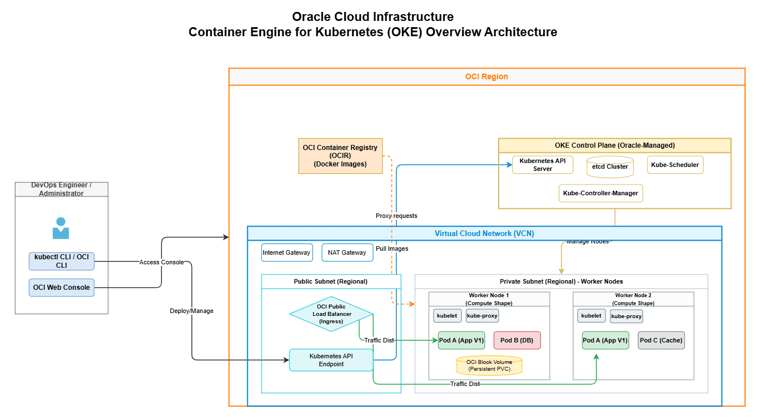
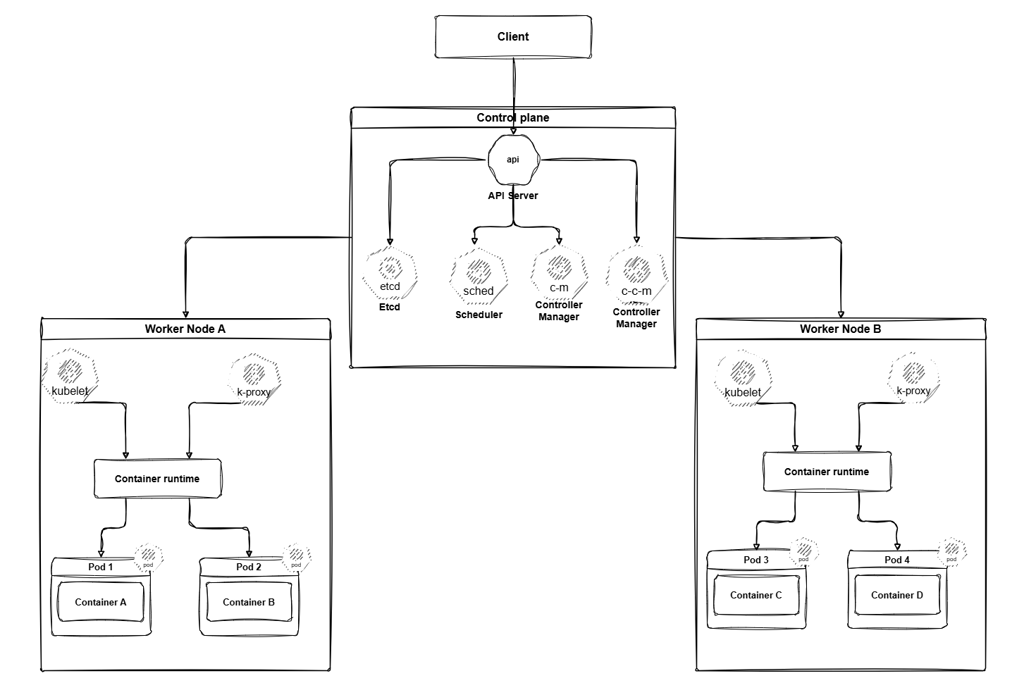
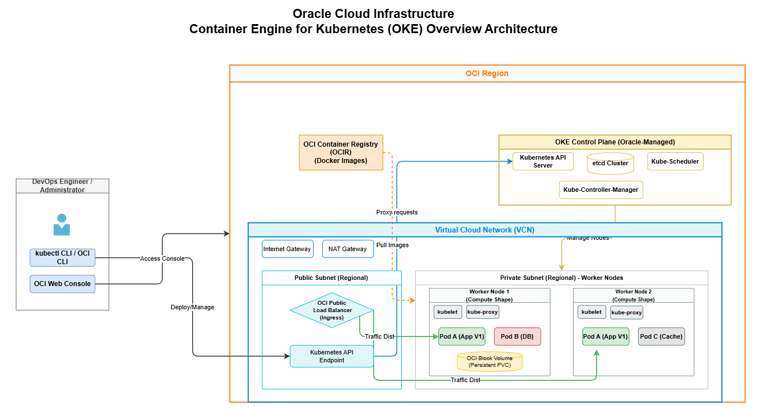
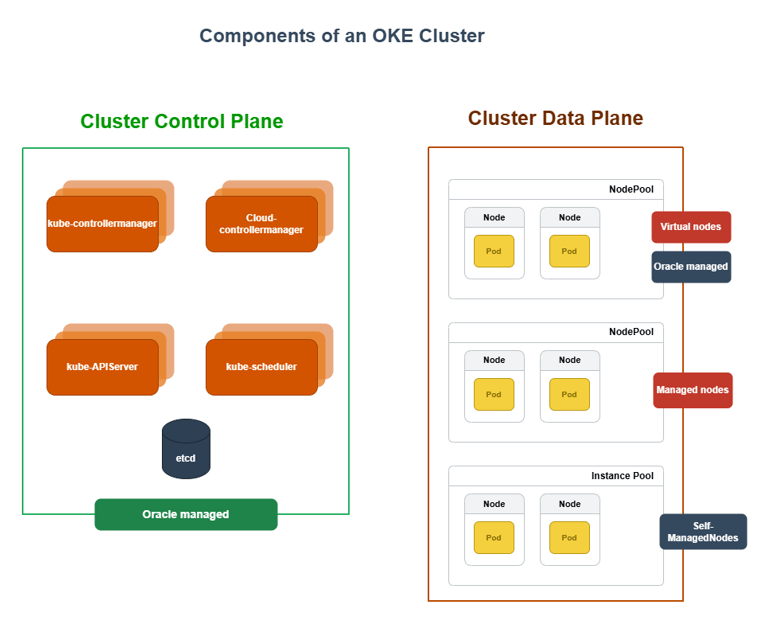
At a high level, every OKE cluster consists of two major components: the Control Plane and the Worker Nodes.
The Control Plane
The control plane acts as the brain of Kubernetes. It continuously evaluates the desired state of the cluster and works to ensure reality matches that desired state.
If a node disappears, the scheduler redistributes workloads.
If a Pod crashes, the ReplicaSet recreates it.
If new workloads require additional capacity, the scheduler places them on appropriate nodes.
Oracle manages this entire layer. Multiple copies of the control plane are automatically distributed across Availability Domains whenever possible, improving resilience without additional customer configuration. This architecture removes one of the most operationally intensive aspects of Kubernetes administration.
Worker Nodes
Worker nodes perform the actual work. Every application container ultimately runs on one of these machines. Unlike the control plane, worker nodes remain under customer control. Architects choose:
compute shape
CPU architecture
memory & storage
node pool design & autoscaling policies
operating system images
placement strategy.
This flexibility allows infrastructure teams to optimize clusters for vastly different workloads:
A machine learning platform may require GPU-enabled worker nodes.
A financial application might prioritize high-memory instances.
A web application serving millions of users could use flexible VM shapes optimized for horizontal scaling.
The same Kubernetes control plane supports all of these scenarios.
Pods: The Smallest Deployable Unit
A common mistake among engineers new to Kubernetes is assuming containers are deployed directly onto nodes. They are not. Kubernetes deploys Pods. A Pod represents one or more tightly coupled containers that share networking and storage resources.
In most production workloads, a Pod contains a single application container. However, sidecar containers have become increasingly common for tasks such as:
log collection agents.
service mesh proxies.
monitoring exporters.
security agents.
Since Pods are the scheduling unit, Kubernetes always places the entire Pod onto the same worker node, simplifying networking while enabling sophisticated deployment strategies.
Why High Availability Begins at the Control Plane
Traditional Kubernetes deployments require administrators to build and maintain highly available master nodes. This introduces significant operational complexity:
multiple control plane servers.
load balancers.
etcd clustering.
certificate management.
backup strategies.
disaster recovery planning.
OKE eliminates nearly all of this work. Oracle provisions and maintains a highly available control plane automatically. As a result, infrastructure teams can concentrate on application resilience instead of platform maintenance. This becomes especially valuable for organizations operating multiple Kubernetes clusters across development, testing, staging, and production environments.
Kubernetes Without Infrastructure Management
One of the more interesting developments in OKE has been Oracle's investment in reducing infrastructure management even further. Historically, Kubernetes administrators spent considerable time maintaining worker nodes on items like:
operating system updates.
Kubernetes upgrades.
capacity planning.
security patching.
autoscaling.
node replacement.
Oracle has extended the managed-service philosophy beyond the control plane through Virtual Nodes, allowing many workloads to run without customers managing worker nodes at all. This changes how platform teams think about Kubernetes operations and allows them to spend more time delivering applications than maintaining infrastructure.
Choosing the Right Cluster Architecture
The architecture you choose for a development environment shouldn't necessarily resemble what you deploy for a customer-facing production application. Oracle introduced multiple deployment options that allow organizations to balance operational simplicity, feature availability, scalability, and cost. Choosing the right model at the beginning can save countless hours of operational work later.
1- Basic Clusters: Keeping Things Simple
When Oracle first introduced OKE, the focus was on delivering a reliable managed Kubernetes service without overwhelming administrators with advanced configuration options. That philosophy remains in today's Basic Clusters.
A Basic Cluster provides everything required to run standard Kubernetes workloads.
You still benefit from:
Oracle-managed control plane.
Managed node pools.
Kubernetes upgrades.
native OCI networking.
Load balancer integration.
Block Volume support.
Identity integration.
Standard Kubernetes APIs.
For many organizations, this is more than enough. Development teams deploying internal business applications rarely require every advanced Kubernetes capability available today. If your workloads consist primarily of internal APIs, web applications, or business services with moderate scaling requirements, a Basic Cluster may be perfectly adequate.
When Basic Clusters Make Sense
I usually recommend Basic Clusters in situations like these:
Development environments where rapid provisioning matters more than advanced customization.
Training environments for Kubernetes learning.
Proof-of-concept projects.
Small production workloads with predictable traffic.
Applications managed by relatively small platform teams.
The key advantage isn't performance; it's operational simplicity. Fewer moving parts generally mean fewer opportunities for configuration mistakes.
Where Basic Clusters Begin to Show Their Limits
As organizations mature their Kubernetes platforms, new operational challenges appear:
Application teams request finer control over cluster add-ons.
Security teams want workload-level identities.
Operations teams begin managing hundreds of worker nodes.
Developers ask for serverless Kubernetes.
These requirements extend beyond what Basic Clusters were originally designed to support, which is precisely why Oracle introduced Enhanced Clusters.
2- Enhanced Clusters: Built for Enterprise Scale
If Basic Clusters focus on simplicity, Enhanced Clusters focus on flexibility. Rather than replacing the Kubernetes architecture, Oracle extended it with additional platform capabilities that address common enterprise requirements. Enhanced Clusters support every capability available in Basic Clusters, but add several features that significantly improve operational efficiency for larger environments.
Financially Backed SLA
This may seem like a contractual detail, but it has architectural implications. Basic Clusters include a Service Level Objective (LO). Enhanced Clusters provide a financially backed Service Level Agreement (SLA).
Production systems increasingly rely on Kubernetes as critical infrastructure. If the Kubernetes API becomes unavailable, automation pipelines stop functioning, deployments fail, autoscaling pauses, and operations teams lose visibility. For organizations operating customer-facing services, the availability of the Kubernetes control plane becomes a business concern rather than merely a technical one.
Cluster Add-ons Become First-Class Citizens
Every Kubernetes administrator eventually discovers that maintaining cluster add-ons can become surprisingly time-consuming. Components like :
CoreDNS.
kube-proxy.
Metrics Server.
Dashboard.
network plugins.
CSI drivers.
each have their own lifecycle, compatibility concerns, and upgrade paths.
Enhanced Clusters improve this experience by allowing administrators to manage add-ons individually. Rather than treating the cluster as one monolithic entity, Oracle allows platform teams to decide:
which add-ons should be installed.
which versions should run.
whether Oracle should automatically update them.
whether specific customizations should be preserved.
Workload Identity Changes the Security Model
Traditional Kubernetes deployments often rely on secrets to authenticate applications against cloud services. That approach works, but it creates operational headaches around credential expiration, rotation management, application redeployments, and tracking access keys.
Oracle's Workload Identity feature changes this model entirely. Instead of distributing credentials inside containers, workloads inherit permissions directly from OCI Identity policies through their Kubernetes Service Accounts.
Applications no longer need embedded API keys.
Credential rotation becomes largely transparent.
Access follows OCI IAM policies directly.
Every API request becomes traceable through OCI Audit.
From a security perspective, this is one of the most significant enhancements Oracle has introduced.
Supporting Larger Clusters
Cluster size is another area where Enhanced Clusters distinguish themselves. Larger environments introduce challenges that smaller deployments rarely encounter.
Scheduling efficiency.
Upgrade coordination.
Monitoring overhead.
Networking complexity.
Node lifecycle management.
Enhanced Clusters increase supported cluster limits, making them suitable for organizations consolidating multiple workloads onto fewer Kubernetes platforms. Consolidation often reduces operational costs while simplifying governance. Instead of managing dozens of medium-sized clusters, organizations can operate fewer highly optimized environments, resulting:
lower infrastructure overhead.
simpler monitoring.
consistent security policies.
centralized platform engineering.
Should Every Cluster Be Enhanced?
Not necessarily.
One mistake is assuming "more features" automatically means "better architecture." Architecture is always contextual. A development cluster supporting five engineers probably gains little value from enterprise-grade workload identity or large-scale node limits. Meanwhile, a production platform hosting dozens of business applications would almost certainly benefit from those capabilities.
Good architects optimize for requirements, not feature counts.
Node Infrastructure Options
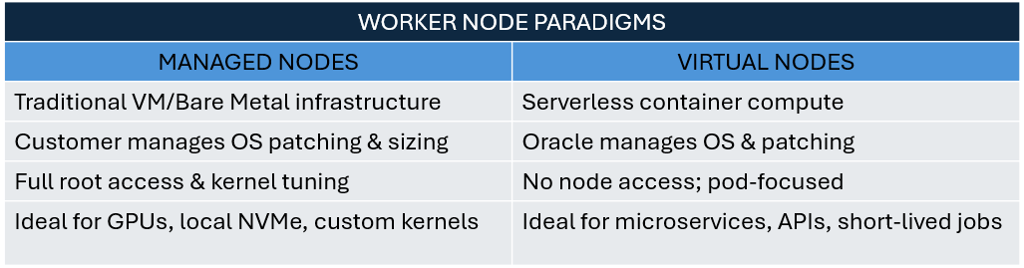
Managed Nodes: The Traditional Kubernetes Experience
Regardless of whether you choose a Basic or Enhanced Cluster, you must decide how to run worker nodes. With Managed Nodes, Oracle provisions the underlying compute instances, which become worker nodes onto which applications are scheduled. Customers retain responsibility for:
capacity planning & scaling.
operating system maintenance.
node upgrades.
resource allocation.
This model offers maximum flexibility. You control the infrastructure, determine the sizing strategy, and decide how workloads should be distributed. Traditional worker nodes remain the preferred option for:
applications requiring GPUs.
machine learning workloads.
database-adjacent services.
applications requiring local NVMe storage.
high-performance computing (HPC).
custom kernel configurations or special networking requirements.
These workloads often depend on infrastructure characteristics that serverless platforms cannot yet expose.
However, that flexibility comes with responsibility. Worker nodes require ongoing attention:
Operating systems need security updates.
Kubernetes versions eventually become unsupported.
node pools require scaling.
Instances occasionally fail.
While Oracle automates many aspects of infrastructure provisioning, operations teams still own the lifecycle of those compute instances. For smaller organizations, this can become a significant operational burden.
Virtual Nodes: Rethinking Kubernetes Infrastructure
Imagine running Kubernetes without maintaining worker nodes:
no operating system patching.
no node replacements.
no scaling node pools.
no infrastructure sizing.
That is essentially the problem Virtual Nodes attempt to solve.
Instead of deploying Pods onto customer-managed compute instances, Oracle schedules workloads onto its serverless container infrastructure. From Kubernetes' perspective, Virtual Nodes still appear as standard nodes, but behind the scenes, Oracle handles the infrastructure. Applications remain unaware of the difference.
Platform engineering teams often spend a disproportionate amount of time managing infrastructure instead of enabling developers. Virtual Nodes shift that balance. Rather than asking how many worker nodes to provision, the conversation becomes focused on how much CPU and memory an application actually requires. Infrastructure planning gradually gives way to workload planning.
Virtual Nodes work particularly well for:
microservices.
REST APIs
event-driven applications.
CI/CD workloads.
short-lived jobs.
burst workloads.
applications with unpredictable traffic.
development environments.
The ability to scale rapidly without managing infrastructure significantly reduces operational overhead.
Virtual Nodes are not a universal replacement, however. Managed Nodes remain the better choice whenever workloads require GPU acceleration, special hardware, custom kernel modules, local NVMe storage, ultra-low latency networking, or infrastructure-level tuning. Serverless Kubernetes is incredibly powerful, but like every architectural decision, it should solve a specific problem rather than become a goal in itself.
OKE Cluster Networking
Ask cloud architects what causes the most production issues, and networking almost always appears near the top of the list. Not because networking is inherently complicated, but because every architectural decision made during cluster deployment eventually depends on it.
Worker nodes need to communicate with the control plane.
Pods must communicate with one another.
Applications consume OCI services.
External users access Load Balancers.
Developers connect to the Kubernetes API.
monitoring systems collect metrics.
CI/CD pipelines deploy applications.
Every one of these interactions depends on a well-designed network.
Unlike compute resources, networking decisions are difficult to reverse once workloads begin running. Rebuilding node pools is manageable; reconfiguring an entire Virtual Cloud Network (VCN) after multiple production applications have been deployed is not.
That's why experienced cloud architects design the network before creating the cluster.
One common mistake is treating Kubernetes as an isolated platform. It isn't. OKE is simply another workload running inside your OCI tenancy. That means it must coexist with databases, application servers, VPN connections, FastConnect circuits, firewalls, monitoring platforms, identity services, and often existing on-premises infrastructure. Instead of asking how to build your Kubernetes cluster, a better question is how Kubernetes should integrate into your broader cloud network. That subtle difference completely changes the design approach.
Virtual Cloud Network (VCN)
Every OKE cluster begins with a Virtual Cloud Network (VCN). Think of the VCN as the private data center that hosts your Kubernetes environment. Everything else subnets, gateways, routing, security rules, worker nodes, Pods, and Load Balancers exists inside it.
Although Oracle allows relatively small CIDR ranges, allocating more address space than initially required is recommended. Kubernetes environments grow. Today's development cluster might contain three worker nodes, but six months later it may host development, integration, testing, production, monitoring, CI/CD tools, service meshes, and GitOps controllers. Running out of IP space is a far more painful problem than allocating a slightly larger CIDR block at the beginning. For most enterprise environments, a /16 network provides a comfortable balance between scalability and simplicity.
IP addresses are inexpensive; network redesign projects are not.
Regional Subnets
Oracle supports both Availability Domain-specific and Regional subnets. Unless a very specific requirement dictates otherwise, Regional subnets are highly recommended. Infrastructure failures rarely occur according to architectural diagrams. Regional subnets simplify:
high availability.
node replacement.
cluster scaling.
disaster recovery.
multi-Availability Domain deployments.
Instead of managing separate networking constructs for every Availability Domain, Regional subnets allow worker nodes to move freely wherever capacity exists across the region.
That flexibility becomes valuable during maintenance windows and unexpected infrastructure events.
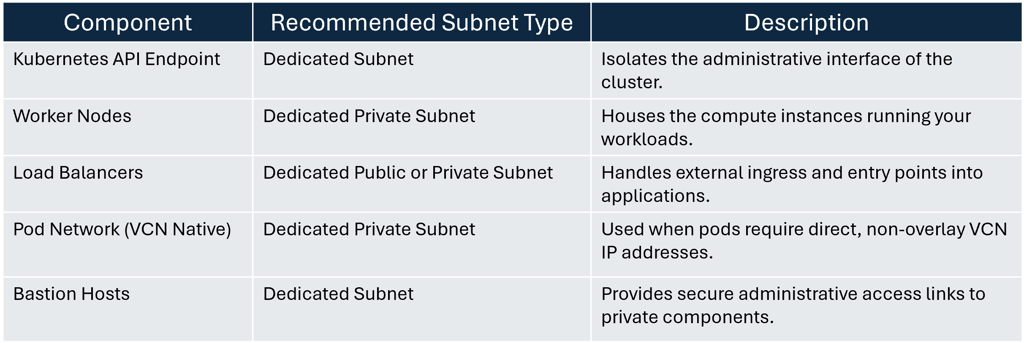
Multiple Subnets
Placing everything inside a single subnet technically works, but operationally it creates unnecessary complexity. Assigning different responsibilities to distinct subnets reduces operational coupling, simplifies security policies, makes traffic patterns more predictable, and improves troubleshooting.
Public or Private Kubernetes API?
The Kubernetes API Server is effectively the administrative interface for your cluster. Anyone with sufficient permissions can deploy applications, modify workloads, or even delete the entire environment. Exposing that interface publicly should therefore be a deliberate architectural decision, not simply the default option.
Public API Endpoint
Public endpoints simplify administration. Developers can connect directly from anywhere with appropriate credentials, and automation pipelines don't require complex VPN connectivity. For development environments, this convenience often outweighs the risks.
Private API Endpoint
Production environments demand tighter controls. Many organizations restrict API access entirely to private networks. Developers connect through a VPN, administrators use Bastion Hosts, and CI/CD pipelines execute inside OCI. External access simply doesn't exist. This significantly reduces the attack surface without affecting Kubernetes itself, making private API endpoints the better choice whenever security requirements are strict.
Worker Nodes
This recommendation remains consistent across almost every enterprise Kubernetes implementation: worker nodes should almost always remain private. They do not need inbound internet connectivity, and users never interact with worker nodes directly. Applications are exposed through Kubernetes Services and Load Balancers, not through the nodes themselves. Keeping worker nodes private improves security while reducing unnecessary exposure.
OCI Gateways
Instead of relying on a single gateway for every scenario, Oracle provides specialized gateways with clearly defined responsibilities. Understanding their roles simplifies network architecture considerably:
Internet Gateway: Provides direct communication between public resources (such as public Load Balancers, public Bastion hosts, or public Kubernetes API endpoints) and the internet.
NAT Gateway: Private resources occasionally need outbound internet access to download operating system updates, retrieve application packages, or communicate with external APIs. The NAT Gateway allows this outbound communication while blocking unsolicited inbound connections. Whenever worker nodes reside inside private subnets, NAT Gateways are required.
Service Gateway: Allows private resources to communicate with Oracle Cloud services without traversing the public internet. When a worker node or pod accesses Object Storage, Container Registry (OCIR), Logging, Monitoring, Vault, or OCI APIs, the traffic remains entirely within Oracle's backbone network. The result is improved security, reduced latency, and simpler firewall policies.
Route Tables and Security Group
Every subnet depends on routing. Public subnets direct internet traffic through the Internet Gateway, while private subnets utilize the NAT Gateway, Service Gateway, or Dynamic Routing Gateway (DRG). One incorrect route can isolate an entire Kubernetes cluster, making route tables one of the first places to investigate during network troubleshooting.
For firewall rules, OCI supports both Security Lists and Network Security Groups (NSGs). While both achieve similar objectives, standardizing on NSGs is highly preferred because they describe workloads rather than entire networks. Instead of writing rules that apply broadly to a subnet, you define rules specifically targeting components (e.g., "Worker Nodes may communicate with the Control Plane" or "Load Balancers may receive HTTPS traffic"). As environments grow, workload-based security scales much better than subnet-based security.
This fits into a broader Zero Trust architectural mindset. Cloud networking has moved away from simple perimeter security. Modern Kubernetes environments assume that resources inside the VCN are not automatically trusted, meaning every communication path must be explicitly authorized using Security Groups, IAM Policies, Workload Identity, and Kubernetes Network Policies.
The Four Production Network Designs Seen Most Often
Pattern 1 – Public API, Private Worker Nodes:
Strikes a good balance between ease of administration and workload security. Administrators can access the cluster without VPN connectivity, while applications remain isolated within private subnets. This is often a sensible choice for development, testing, and smaller production environments.
Pattern 2 – Private API, Private Worker Nodes:
This is the recommended model for most enterprise production platforms. Nothing administrative is exposed directly to the internet. Access is routed through VPNs, Bastion Hosts, or private OCI connectivity, minimizing the attack surface.
Pattern 3 – OCI VCN-Native Networking with Public Load Balancers:
Only the application entry points are internet-facing. The control plane, worker nodes, and Pods remain private, while OCI's VCN-Native CNI gives each Pod its own private IP address out of the VCN. This approach provides excellent visibility and integrates naturally with OCI networking and security services.
Pattern 4 – Fully Private Kubernetes Platform: Standard in highly regulated sectors such as government, banking, and healthcare. Every single Kubernetes component remains private. Users connect through internal corporate networks, applications are published through internal reverse proxies or dedicated edge services, and no part of the infrastructure is reachable from the public internet.
Pod Networking and Architecture Best Practices
Most developers never think about pod networking; applications simply communicate, and everything appears to work. Architects, however, know that networking decisions made at the pod layer directly affect scalability, observability, security, troubleshooting, and cloud costs. Choosing the wrong networking model can create operational challenges that are difficult to undo without completely rebuilding the cluster.
One of Kubernetes' design principles is that every Pod should have its own IP address. This allows applications to communicate directly without complicated port mapping, without Network Address Translation (NAT) between Pods, and without requiring application awareness of the underlying infrastructure. Every workload behaves as though it exists on the same flat network.
The challenge is making that networking model work efficiently across hundreds or thousands of Pods running on many worker nodes. That's where the Container Network Interface (CNI) comes in.
Understanding the Role of CNI
The Container Network Interface (CNI) isn't a networking product; it's a specification. Think of it as a contract that defines how Kubernetes asks networking software to connect Pods to the network. Whenever Kubernetes creates a Pod, it delegates networking responsibilities to the installed CNI plugin, which handles:
assigning an IP address.
creating network interfaces.
connecting Pods.
configuring routing.
maintaining connectivity.
Oracle Kubernetes Engine supports two distinct networking models:
Flannel
OCI VCN-Native Networking.
Neither is universally better; the right choice depends entirely on your architectural goals.
Flannel CNI: Simple, Reliable, and Proven
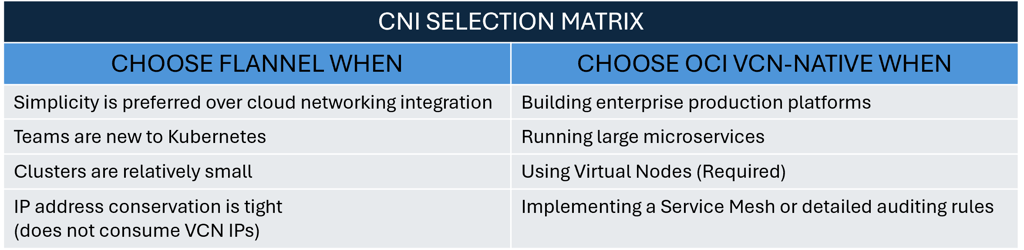
Flannel has been part of the Kubernetes ecosystem for years, valued primarily for its simplicity. Rather than exposing every Pod directly inside the Virtual Cloud Network, Flannel creates an overlay network. Pods receive IP addresses from this overlay block rather than drawing directly from your VCN allocation. To Kubernetes, everything behaves normally, and the underlying overlay implementation remains largely invisible.
Flannel works extremely well when operational simplicity is the primary objective. It performs reliably in environments hosting:
internal business applications.
CI/CD environments.
development clusters.
test environments.
Small production workloads.
The operational model is easy to understand, network planning is straightforward, cluster deployment is quick, and troubleshooting is relatively uncomplicated.
The trade-off is that overlay networking introduces an additional abstraction layer. While this isn't noticeable most of the time, larger enterprise environments often require tighter integration with cloud networking for direct Pod visibility, granular security policies, advanced routing, service meshes, and cloud-native monitoring. That is where OCI's VCN-Native CNI excels.
OCI VCN-Native Pod Networking: Direct Cloud Integration
With OCI VCN-Native networking, the overlay abstraction is removed. Pods receive actual, routable IP addresses directly from your Virtual Cloud Network subnets. Pods effectively become first-class citizens inside your cloud network: each Pod can be addressed directly, OCI networking understands them, OCI security policies can reference them, and OCI monitoring tools gain direct visibility.
Imagine troubleshooting communication between two microservices. With traditional overlay networking, administrators must translate between worker nodes, overlay addresses, and virtual routing layers. With OCI VCN-Native networking, the Pod exists directly inside your cloud network, meaning the same diagnostic tools used to investigate virtual machines can be used to investigate Pods, reducing operational complexity for infrastructure teams.
Security also improves naturally. Because Pods receive real VCN IP addresses, they integrate with native OCI security capabilities like:
Network Security Groups.
fine-grained routing.
security auditing
Identity-aware networking.
Service Gateway communication.
Which CNI Do I Recommend?
Managing Access: Complementing RBAC with OCI IAM
Networking protects traffic, but identity protects resources.
Many Kubernetes administrators focus heavily on internal Role-Based Access Control (RBAC) while overlooking cloud IAM. In reality, both layers complement each other: OCI IAM controls access to Oracle Cloud resources, while Kubernetes RBAC controls permissions inside the cluster itself. Using them together provides a strong security posture.
As discussed under Enhanced Clusters, implementing Workload Identity eliminates the need to distribute or hardcode API keys inside containers. Pods inherit permissions through Kubernetes Service Accounts mapped directly to OCI IAM policies, simplifying credential rotation and making every API call fully traceable.
Common Enterprise Anti-Patterns to Avoid
Even experienced engineering teams occasionally fall into predictable, counterproductive patterns when running OKE in production:
Treating Worker Nodes like Traditional Virtual Machines:
Worker nodes are ephemeral infrastructure, not permanent application servers. Avoid logging into them manually via SSH to make configuration changes or install packages directly. Everything must be reproducible through automation and managed via Infrastructure as Code (IaC).
Deploying Public Worker Nodes:
There are very few situations where worker nodes require public IP addresses. Expose your applications through managed OCI Load Balancers instead, and keep your core compute infrastructure private.
Building Large Snowflake Clusters:
Every cluster should follow consistent, automated standards. If every environment contains unique manual tweaks and custom deployment scripts, platform upgrades become increasingly difficult to execute and maintain.
Ignoring Upgrade Planning:
Kubernetes evolves quickly, and older versions regularly hit end-of-support. Platforms must be designed with updates in mind from day one. Waiting until a version is completely deprecated before testing upgrades introduces severe operational risk.
Excessive, Non-Standard Customization:
Custom images, custom kernel scripts, non-standard networking overlays, and bespoke deployment paths may seem harmless individually. Combined, they produce fragile environments that diverge from supported Oracle practices, increasing long-term maintenance overhead.
The Production Readiness Checklist
Before moving live business traffic onto an OKE cluster, verify that your architecture satisfies the following baseline questions:
[ ] Private API Endpoint:
Is the Kubernetes API endpoint locked down via private subnets or strictly restricted via NSG whitelists?
[ ] Private Worker Nodes:
Are worker nodes completely isolated from direct inbound internet exposure inside private subnets?
[ ] Infrastructure as Code:
Is the entire environment (VCN, gateways, clusters, and node pools) provisioned and tracked via Terraform or OCI Resource Manager?
[ ] Standardized Images:
Are worker node operating system images standardized using minimal, OKE-optimized platform configurations?
[ ] Workload Firewalls:
Are Network Security Groups (NSGs) leveraged to define clear boundaries between workloads instead of large, generic subnet Security Lists?
[ ] Workload Identity:
Is OCI Workload Identity used to eliminate hardcoded API keys and long-lived cloud secrets inside application containers?
[ ] Observability Baseline:
Are centralized cloud logging and monitoring solutions configured and validated before production traffic arrives?
[ ] Autoscaling Validation:
Have both cluster-level and pod-level autoscaling policies been load-tested under realistic traffic conditions?
[ ] Documented Upgrades:
Is there a clear, rehearsed operational runbook for executing rolling node pool upgrades with zero application downtime?
[ ] Validated Disaster Recovery:
Has the cluster's backup, restore, and failover process been explicitly tested and verified?
[ ] Separation of Duties:
Are application development teams restricted from modifying core cluster network and infrastructure components directly?
[ ] Cost Governance:
Are OCI budgets, compartments, and cost-tracking tags deployed to monitor resource usage by environment or business unit?
Conclusion
Oracle Kubernetes Engine has matured into a highly capable enterprise platform. From a technical perspective, it delivers exactly what infrastructure teams expect from a managed Kubernetes service: a resilient control plane, flexible compute models, tight integration with cloud networking and identity systems, and adherence to upstream standards.
What sets successful OKE deployments apart, however, isn't the technology alone. It is the quality of the architectural decisions made before the first application is ever deployed. The choices you make around VCN subnet layout, CNI selection, security boundaries, and infrastructure automation will shape your operational efficiency long after initial deployment is complete.
Kubernetes itself is no longer the difficult part of the equation. Building a clean, predictable platform that engineering teams can operate confidently and securely for years is where thoughtful architecture makes the difference. When approached systematically, OKE provides a highly stable, scalable foundation that integrates naturally with the broader Oracle Cloud ecosystem.
© 2026. All rights reserved.
Stay Updated
Get the latest posts on OCI and cloud tech